general
English Thesaurus
1. a fact about the whole (as opposed to particular) (noun.cognition)
| hypernym | : | fact, |
| definition | : | a piece of information about circumstances that exist or events that have occurred (noun.cognition) |
2. a general officer of the highest rank (noun.person)
| hypernym | : | general officer, |
| definition | : | officers in the Army or Air Force or Marines above the rank of colonel (noun.person) |
| instance hyponym | : | agricola, gnaeus julius agricola, |
| definition | : | Roman general who was governor of Britain and extended Roman rule north to the Firth of Forth (37-93) (noun.person) |
| instance hyponym | : | alcibiades, |
| definition | : | ancient Athenian statesman and general in the Peloponnesian War (circa 450-404 BC) (noun.person) |
| instance hyponym | : | antigonus, antigonus cyclops, monophthalmos, |
| definition | : | a general of Alexander the Great and king of Macedonia; lost one eye; killed in a battle at Ipsus (382-301 BC) (noun.person) |
| instance hyponym | : | arnold, benedict arnold, |
| definition | : | United States general and traitor in the American Revolution; in 1780 his plan to surrender West Point to the British was foiled (1741-1801) (noun.person) |
| instance hyponym | : | belisarius, |
| definition | : | Byzantine general under Justinian I; he recovered former Roman territories in northern Africa and fought against the Persians (noun.person) |
| instance hyponym | : | belshazzar, |
| definition | : | (Old Testament) Babylonian general and son of Nebuchadnezzar II; according to the Old Testament he was warned of his doom by divine handwriting on the wall that was interpreted by Daniel (6th century BC) (noun.person) |
| instance hyponym | : | bolivar, el libertador, simon bolivar, |
| definition | : | Venezuelan statesman who led the revolt of South American colonies against Spanish rule; founded Bolivia in 1825 (1783-1830) (noun.person) |
| instance hyponym | : | bragg, braxton bragg, |
| definition | : | Confederate general during the American Civil War who was defeated by Grant in the battle of Chattanooga (1817-1876) (noun.person) |
| instance hyponym | : | burgoyne, gentleman johnny, john burgoyne, |
| definition | : | British general in the American Revolution who captured Fort Ticonderoga but lost the battle of Saratoga in 1777 (1722-1792) (noun.person) |
| instance hyponym | : | chiang chung-cheng, chiang kai-shek, |
| definition | : | Chinese military and political figure; in the Chinese civil war that followed World War II he was defeated by the Chinese communists and in 1949 was forced to withdraw to Taiwan where he served as president of Nationalist China until his death (1897-1975) (noun.person) |
| instance hyponym | : | clark, mark clark, mark wayne clark, |
| definition | : | United States general who was Allied commander in Africa and Italy in World War II and was commander of the United Nations forces in Korea (1896-1984) (noun.person) |
| instance hyponym | : | clausewitz, karl von clausewitz, |
| definition | : | Prussian general and military theorist who proposed a doctrine of total war and war as an extension of diplomacy (1780-1831) (noun.person) |
| instance hyponym | : | clay, lucius clay, lucius dubignon clay, |
| definition | : | United States general who commanded United States forces in Europe from 1945 to 1949 and who oversaw the Berlin airlift (1897-1978) (noun.person) |
| instance hyponym | : | cromwell, ironsides, oliver cromwell, |
| definition | : | English general and statesman who led the parliamentary army in the English Civil War (1599-1658) (noun.person) |
| instance hyponym | : | dayan, moshe dayan, |
| definition | : | Israeli general and statesman (1915-1981) (noun.person) |
| instance hyponym | : | doolittle, james harold doolittle, jimmy doolittle, |
| definition | : | United States Air Force officer who electrified the world in 1942 by leading a squadron of 16 bombers on a daylight raid over Tokyo (1896-1993) (noun.person) |
| instance hyponym | : | eugene, prince eugene of savoy, |
| definition | : | Austrian general in the service of the Holy Roman Empire during the War of the Spanish Succession (1663-1736) (noun.person) |
| instance hyponym | : | flaminius, gaius flaminius, |
| definition | : | Roman statesman and general who built the Flaminian Way; died when he was defeated by Hannibal (died 217 BC) (noun.person) |
| instance hyponym | : | garibaldi, giuseppe garibaldi, |
| definition | : | Italian patriot whose conquest of Sicily and Naples led to the formation of the Italian state (1807-1882) (noun.person) |
| instance hyponym | : | groves, leslie richard groves, |
| definition | : | United States general who served as military director of the atomic bomb project (1896-1970) (noun.person) |
| instance hyponym | : | hannibal, |
| definition | : | general who commanded the Carthaginian army in the second Punic War; crossed the Alps and defeated the Romans but was recalled to defend Carthage and was defeated (247-182 BC) (noun.person) |
| instance hyponym | : | bomber harris, harris, sir arthur travers harris, |
| definition | : | British marshal of the Royal Air Force; during World War II he directed mass bombing raids against German cities that resulted in heavy civilian casualties (1892-1984) (noun.person) |
| instance hyponym | : | hasdrubal, |
| definition | : | general who commanded a Carthaginian army in Spain; joined his brother Hannibal in Italy and was killed by the Romans at the battle of Metaurus River (died 207 BC) (noun.person) |
| instance hyponym | : | holofernes, |
| definition | : | (Apocrypha) the Assyrian general who was decapitated by the biblical heroine Judith (noun.person) |
| instance hyponym | : | fighting joe hooker, hooker, joseph hooker, |
| definition | : | United States general in the Union Army who was defeated at Chancellorsville by Robert E. Lee (1814-1879) (noun.person) |
| instance hyponym | : | houston, sam houston, samuel houston, |
| definition | : | United States politician and military leader who fought to gain independence for Texas from Mexico and to make it a part of the United States (1793-1863) (noun.person) |
| instance hyponym | : | andrew jackson, jackson, old hickory, |
| definition | : | 7th president of the US; successfully defended New Orleans from the British in 1815; expanded the power of the presidency (1767-1845) (noun.person) |
| instance hyponym | : | lee, robert e. lee, robert edward lee, |
| definition | : | American general who led the Confederate Armies in the American Civil War (1807-1870) (noun.person) |
| instance hyponym | : | lysander, |
| definition | : | Spartan general who defeated the Athenians in the final battle of the Peloponnesian War (died in 395 BC) (noun.person) |
| instance hyponym | : | lysimachus, |
| definition | : | Macedonian general under Alexander the Great; with Seleucus he defeated Antigonus and Demetrius at the battle of Ipsus (circa 355-281 BC) (noun.person) |
| instance hyponym | : | douglas macarthur, macarthur, |
| definition | : | United States general who served as chief of staff and commanded Allied forces in the South Pacific during World War II; he accepted the surrender of Japan (1880-1964) (noun.person) |
| instance hyponym | : | george gordon meade, meade, |
| definition | : | United States general in charge of the Union troops at the Battle of Gettysburg (1815-1872) (noun.person) |
| instance hyponym | : | miltiades, |
| definition | : | Athenian general who defeated the Persians at Marathon (540-489) (noun.person) |
| instance hyponym | : | george edward pickett, pickett, |
| definition | : | American Confederate general known for leading a disastrous charge at Gettysburg (1825-1875) (noun.person) |
| instance hyponym | : | colin luther powell, colin powell, powell, |
| definition | : | United States general who was the first African American to serve as chief of staff; later served as Secretary of State under President George W. Bush (born 1937) (noun.person) |
| instance hyponym | : | scott, winfield scott, |
| definition | : | United States general who was a hero of the War of 1812 and who defeated Santa Anna in the Mexican War (1786-1866) (noun.person) |
| instance hyponym | : | seleucus, seleucus i, seleucus i nicator, |
| definition | : | Macedonian general who accompanied Alexander the Great into Asia; founded a line of kings who reigned in Asia Minor until 65 BC (358-281 BC) (noun.person) |
| instance hyponym | : | sherman, william tecumseh sherman, |
| definition | : | United States general who was commander of all Union troops in the West; he captured Atlanta and led a destructive march to the sea that cut the Confederacy in two (1820-1891) (noun.person) |
| instance hyponym | : | siraj-ud-daula, |
| definition | : | Indian general and nawab of Bengal who opposed the colonization of India by England; he captured Calcutta in 1756 and many of his prisoners suffocated in a crowded room that became known as the Black Hole of Calcutta; he was defeated at the battle of Plassey by a group of Indian nobles in alliance with Robert Clive (1728-1757) (noun.person) |
| instance hyponym | : | xenophon, |
| definition | : | Greek general and historian; student of Socrates (430-355 BC) (noun.person) |
3. the head of a religious order or congregation (noun.person)
| hypernym | : | chief, head, top dog, |
| definition | : | a person who is in charge (noun.person) |
4. command as a general (verb.communication)
| hypernym | : | command, |
| definition | : | be in command of (verb.communication) |
5. prevailing among and common to the general public (adj.all)
| similar | : | common, |
| definition | : | having no special distinction or quality; widely known or commonly encountered; average or ordinary or usual (adj.all) |
6. of worldwide scope or applicability (adj.all)
| similar | : | comprehensive, |
| definition | : | including all or everything (adj.all) |
7. not specialized or limited to one class of things (adj.all)
8. applying to all or most members of a category or group (adj.all)
| similar | : | generic, |
| definition | : | applicable to an entire class or group (adj.all) |
| similar | : | gross, |
| definition | : | lacking fine distinctions or detail (adj.all) |
| similar | : | overall, |
| definition | : | involving only main features (adj.all) |
| similar | : | pandemic, |
| definition | : | existing everywhere (adj.all) |
| similar | : | universal, |
| definition | : | applicable to or common to all members of a group or set (adj.all) |
| similar | : | widespread, |
| definition | : | widely circulated or diffused (adj.all) |
| also | : | comprehensive, |
| definition | : | including all or everything (adj.all) |
| also | : | indiscriminate, |
| definition | : | not marked by fine distinctions (adj.all) |
| also | : | imprecise, |
| definition | : | not precise (adj.all) |
| attribute | : | generality, |
| definition | : | the quality of being general or widespread or having general applicability (noun.attribute) |
9. affecting the entire body (adj.all)
| similar | : | systemic, |
| definition | : | affecting an entire system (adj.all) |
| domain category | : | medical specialty, medicine, |
| definition | : | the branches of medical science that deal with nonsurgical techniques (noun.cognition) |
10. somewhat indefinite (adj.all)
| similar | : | imprecise, |
| definition | : | not precise (adj.all) |
11. a fact about the whole (as opposed to particular) (noun.cognition)
| antonym | : | particular, specific, |
| definition | : | a fact about some part (as opposed to general) (noun.cognition) |
| derivation | : | general, |
| definition | : | not specialized or limited to one class of things (adj.all) |
| derivation | : | general, |
| definition | : | applying to all or most members of a category or group (adj.all) |
12. a general officer of the highest rank (noun.person)
| derivation | : | generalship, |
| definition | : | the leadership ability of a military general (noun.cognition) |
| derivation | : | general, |
| definition | : | command as a general (verb.communication) |
13. the head of a religious order or congregation (noun.person)
14. command as a general (verb.communication)
| derivation | : | full general, general, |
| definition | : | a general officer of the highest rank (noun.person) |
15. of worldwide scope or applicability (adj.all)
| derivation | : | catholicity, universality, |
| definition | : | the quality of being universal; existing everywhere (noun.attribute) |
16. not specialized or limited to one class of things (adj.all)
| derivation | : | generality, |
| definition | : | the quality of being general or widespread or having general applicability (noun.attribute) |
| derivation | : | general, |
| definition | : | a fact about the whole (as opposed to particular) (noun.cognition) |
17. applying to all or most members of a category or group (adj.all)
| antonym | : | specific, |
| definition | : | (sometimes followed by `to') applying to or characterized by or distinguishing something particular or special or unique (adj.all) |
| derivation | : | generality, |
| definition | : | the quality of being general or widespread or having general applicability (noun.attribute) |
| derivation | : | general, |
| definition | : | a fact about the whole (as opposed to particular) (noun.cognition) |
18. affecting the entire body (adj.all)
| antonym | : | local, |
| definition | : | affecting only a restricted part or area of the body (adj.all) |
| derivation | : | generality, |
| definition | : | the quality of being general or widespread or having general applicability (noun.attribute) |
19. a fact about the whole (as opposed to particular) (noun.cognition)
| antonym | : | particular, specific, |
| definition | : | a fact about some part (as opposed to general) (noun.cognition) |
| derivation | : | general, |
| definition | : | not specialized or limited to one class of things (adj.all) |
| derivation | : | general, |
| definition | : | applying to all or most members of a category or group (adj.all) |
20. a general officer of the highest rank (noun.person)
| derivation | : | generalship, |
| definition | : | the leadership ability of a military general (noun.cognition) |
| derivation | : | general, |
| definition | : | command as a general (verb.communication) |
21. the head of a religious order or congregation (noun.person)
22. command as a general (verb.communication)
| derivation | : | full general, general, |
| definition | : | a general officer of the highest rank (noun.person) |
23. of worldwide scope or applicability (adj.all)
| derivation | : | catholicity, universality, |
| definition | : | the quality of being universal; existing everywhere (noun.attribute) |
24. not specialized or limited to one class of things (adj.all)
| derivation | : | generality, |
| definition | : | the quality of being general or widespread or having general applicability (noun.attribute) |
| derivation | : | general, |
| definition | : | a fact about the whole (as opposed to particular) (noun.cognition) |
25. applying to all or most members of a category or group (adj.all)
| antonym | : | specific, |
| definition | : | (sometimes followed by `to') applying to or characterized by or distinguishing something particular or special or unique (adj.all) |
| derivation | : | generality, |
| definition | : | the quality of being general or widespread or having general applicability (noun.attribute) |
| derivation | : | general, |
| definition | : | a fact about the whole (as opposed to particular) (noun.cognition) |
26. affecting the entire body (adj.all)
| antonym | : | local, |
| definition | : | affecting only a restricted part or area of the body (adj.all) |
| derivation | : | generality, |
| definition | : | the quality of being general or widespread or having general applicability (noun.attribute) |
Visual ArtiKata
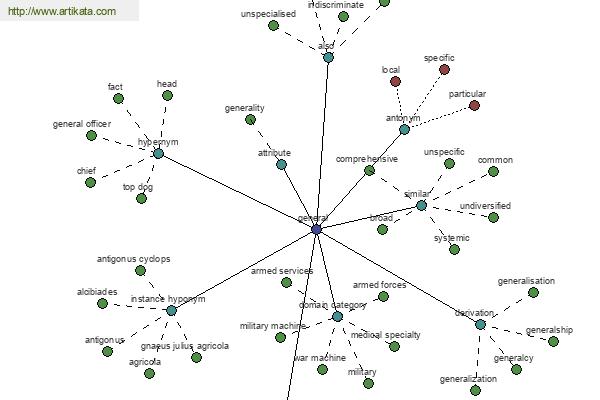 Explore general in ArtiKata.com >