linguistics
English Thesaurus
1. the humanistic study of language and literature (noun.cognition)
| hyponym | : | dialectology, |
| definition | : | the branch of philology that is devoted to the study of dialects (noun.cognition) |
| hyponym | : | lexicology, |
| definition | : | the branch of linguistics that studies the lexical component of language (noun.cognition) |
2. the scientific study of language (noun.cognition)
| hyponym | : | etymology, |
| definition | : | the study of the sources and development of words (noun.cognition) |
| hyponym | : | neurolinguistics, |
| definition | : | the branch of linguistics that studies the relation between language and the structure and function of the nervous system (noun.cognition) |
| hyponym | : | pragmatics, |
| definition | : | the study of language use (noun.cognition) |
| hyponym | : | semantics, |
| definition | : | the study of language meaning (noun.cognition) |
| hyponym | : | sociolinguistics, |
| definition | : | the study of language in relation to its sociocultural context (noun.cognition) |
| hyponym | : | synchronic linguistics, |
| definition | : | the study of a language without reference to its historical context (noun.cognition) |
| hyponym | : | descriptive linguistics, |
| definition | : | a description (at a given point in time) of a language with respect to its phonology and morphology and syntax and semantics without value judgments (noun.cognition) |
| hyponym | : | prescriptive linguistics, |
| definition | : | an account of how a language should be used instead of how it is actually used; a prescription for the `correct' phonology and morphology and syntax and semantics (noun.cognition) |
| part meronym | : | cognitive science, |
| definition | : | the field of science concerned with cognition; includes parts of cognitive psychology and linguistics and computer science and cognitive neuroscience and philosophy of mind (noun.cognition) |
| domain member category | : | linguistic performance, |
| definition | : | (linguistics) a speaker's actual use of language in real situations; what the speaker actually says, including grammatical errors and other non-linguistic features such as hesitations and other disfluencies (contrasted with linguistic competence) (noun.act) |
| domain member category | : | tone, |
| definition | : | (linguistics) a pitch or change in pitch of the voice that serves to distinguish words in tonal languages (noun.attribute) |
| domain member category | : | complementary distribution, complementation, |
| definition | : | (linguistics) a distribution of related speech sounds or forms in such a way that they only appear in different contexts (noun.attribute) |
| domain member category | : | linguistic competence, |
| definition | : | (linguistics) a speaker's implicit, internalized knowledge of the rules of their language (contrasted with linguistic performance) (noun.attribute) |
| domain member category | : | feature, feature of speech, |
| definition | : | (linguistics) a distinctive characteristic of a linguistic unit that serves to distinguish it from other units of the same kind (noun.cognition) |
| domain member category | : | grammar, |
| definition | : | the branch of linguistics that deals with syntax and morphology (and sometimes also deals with semantics) (noun.cognition) |
| domain member category | : | descriptive grammar, |
| definition | : | a grammar that is produced by descriptive linguistics (noun.cognition) |
| domain member category | : | prescriptive grammar, |
| definition | : | a grammar that is produced by prescriptive linguistics (noun.cognition) |
| domain member category | : | syntax, |
| definition | : | studies of the rules for forming admissible sentences (noun.cognition) |
| domain member category | : | generative grammar, |
| definition | : | (linguistics) a type of grammar that describes syntax in terms of a set of logical rules that can generate all and only the infinite number of grammatical sentences in a language and assigns them all the correct structural description (noun.cognition) |
| domain member category | : | phonemics, phonology, |
| definition | : | the study of the sound system of a given language and the analysis and classification of its phonemes (noun.cognition) |
| domain member category | : | descriptivism, |
| definition | : | (linguistics) a doctrine supporting or promoting descriptive linguistics (noun.cognition) |
| domain member category | : | prescriptivism, |
| definition | : | (linguistics) a doctrine supporting or promoting prescriptive linguistics (noun.cognition) |
| domain member category | : | derivative, |
| definition | : | (linguistics) a word that is derived from another word (noun.communication) |
| domain member category | : | descriptor, form, signifier, word form, |
| definition | : | the phonological or orthographic sound or appearance of a word that can be used to describe or identify something (noun.communication) |
| domain member category | : | participant role, semantic role, |
| definition | : | (linguistics) the underlying relation that a constituent has with the main verb in a clause (noun.communication) |
| domain member category | : | postposition, |
| definition | : | (linguistics) the placing of one linguistic element after another (as placing a modifier after the word that it modifies in a sentence or placing an affix after the base to which it is attached) (noun.communication) |
| domain member category | : | preposition, |
| definition | : | (linguistics) the placing of one linguistic element before another (as placing a modifier before the word it modifies in a sentence or placing an affix before the base to which it is attached) (noun.communication) |
| domain member category | : | topicalization, |
| definition | : | (linguistics) emphasis placed on the topic or focus of a sentence by preposing it to the beginning of the sentence; placing the topic at the beginning of the sentence is typical for English (noun.communication) |
| domain member category | : | morphophoneme, |
| definition | : | (linguistics) the phonemes (or strings of phonemes) that constitute the various allomorphs of a morpheme (noun.communication) |
| domain member category | : | phoneme, |
| definition | : | (linguistics) one of a small set of speech sounds that are distinguished by the speakers of a particular language (noun.communication) |
| domain member category | : | allophone, |
| definition | : | (linguistics) any of various acoustically different forms of the same phoneme (noun.communication) |
| domain member category | : | linguistic rule, rule, |
| definition | : | (linguistics) a rule describing (or prescribing) a linguistic practice (noun.communication) |
| domain member category | : | linguistic universal, universal, |
| definition | : | (linguistics) a grammatical rule (or other linguistic feature) that is found in all languages (noun.communication) |
| domain member category | : | sign, |
| definition | : | a fundamental linguistic unit linking a signifier to that which is signified (noun.communication) |
| domain member category | : | phylum, |
| definition | : | (linguistics) a large group of languages that are historically related (noun.group) |
| domain member category | : | aphaeresis, apheresis, |
| definition | : | (linguistics) omission at the beginning of a word as in `coon' for `raccoon' or `till' for `until' (noun.process) |
| domain member category | : | linguistic process, |
| definition | : | a process involved in human language (noun.process) |
| domain member category | : | voice, |
| definition | : | (linguistics) the grammatical relation (active or passive) of the grammatical subject of a verb to the action that the verb denotes (noun.linkdef) |
| domain member category | : | obscure, |
| definition | : | reduce a vowel to a neutral one, such as a schwa (verb.change) |
| domain member category | : | reduce, |
| definition | : | destress and thus weaken a sound when pronouncing it (verb.change) |
| domain member category | : | topicalize, |
| definition | : | emphasize by putting heavy stress on or by moving to the front of the sentence (verb.communication) |
| domain member category | : | analytic, uninflected, |
| definition | : | expressing a grammatical category by using two or more words rather than inflection (adj.all) |
| domain member category | : | synthetic, |
| definition | : | systematic combining of root and modifying elements into single words (adj.all) |
| domain member category | : | animate, |
| definition | : | belonging to the class of nouns that denote living beings (adj.all) |
| domain member category | : | inanimate, |
| definition | : | belonging to the class of nouns denoting nonliving things (adj.all) |
| domain member category | : | cacuminal, retroflex, |
| definition | : | pronounced with the tip of the tongue turned back toward the hard palate (adj.all) |
| domain member category | : | inflected, |
| definition | : | showing alteration in form (especially by the addition of affixes) (adj.all) |
| domain member category | : | uninflected, |
| definition | : | not inflected (adj.all) |
| domain member category | : | early, |
| definition | : | of an early stage in the development of a language or literature (adj.all) |
| domain member category | : | old, |
| definition | : | of a very early stage in development (adj.all) |
| domain member category | : | middle, |
| definition | : | of a stage in the development of a language or literature between earlier and later stages (adj.all) |
| domain member category | : | late, |
| definition | : | of a later stage in the development of a language or literature; used especially of dead languages (adj.all) |
| domain member category | : | modern, new, |
| definition | : | used of a living language; being the current stage in its development (adj.all) |
| domain member category | : | new, |
| definition | : | in use after medieval times (adj.all) |
| domain member category | : | cognate, |
| definition | : | having the same ancestral language (adj.all) |
| domain member category | : | received, standard, |
| definition | : | conforming to the established language usage of educated native speakers (adj.all) |
| domain member category | : | acceptable, |
| definition | : | judged to be in conformity with approved usage (adj.all) |
| domain member category | : | nonstandard, |
| definition | : | not conforming to the language usage of a prestige group within a community (adj.all) |
| domain member category | : | bad, |
| definition | : | nonstandard (adj.all) |
| domain member category | : | suprasegmental, |
| definition | : | pertaining to a feature of speech that extends over more than a single speech sound (adj.all) |
| domain member category | : | segmental, |
| definition | : | divided or organized into speech segments or isolable speech sounds (adj.all) |
| domain member category | : | autosemantic, |
| definition | : | of a word or phrase meaningful in isolation, independent of context (adj.all) |
| domain member category | : | synsemantic, |
| definition | : | of a word or phrase meaningful only when it occurs in the company of other words (adj.all) |
| domain member category | : | radical, |
| definition | : | of or relating to or constituting a linguistic root (adj.pert) |
| domain member category | : | polyphonic, |
| definition | : | having two or more phonetic values (adj.pert) |
| domain member category | : | homophonous, |
| definition | : | characteristic of the phenomenon of words of different origins that are pronounced the same way (adj.pert) |
| domain member category | : | ablative, |
| definition | : | relating to the ablative case (adj.pert) |
| domain member category | : | aspectual, |
| definition | : | of or belonging to an aspect (as an aspect of the verb) (adj.pert) |
| domain member category | : | prepositional, |
| definition | : | of or relating to or formed with a preposition (adj.pert) |
| domain member category | : | vocative, |
| definition | : | relating to a case used in some languages (adj.pert) |
3. the humanistic study of language and literature (noun.cognition)
| derivation | : | philologist, philologue, |
| definition | : | a humanist specializing in classical scholarship (noun.person) |
| derivation | : | lingual, linguistic, |
| definition | : | consisting of or related to language (adj.pert) |
| derivation | : | philological, |
| definition | : | of or relating to or dealing with philology (adj.pert) |
4. the scientific study of language (noun.cognition)
| derivation | : | linguistic, |
| definition | : | of or relating to the scientific study of language (adj.pert) |
5. the humanistic study of language and literature (noun.cognition)
| derivation | : | philologist, philologue, |
| definition | : | a humanist specializing in classical scholarship (noun.person) |
| derivation | : | lingual, linguistic, |
| definition | : | consisting of or related to language (adj.pert) |
| derivation | : | philological, |
| definition | : | of or relating to or dealing with philology (adj.pert) |
6. the scientific study of language (noun.cognition)
| derivation | : | linguistic, |
| definition | : | of or relating to the scientific study of language (adj.pert) |
Visual ArtiKata
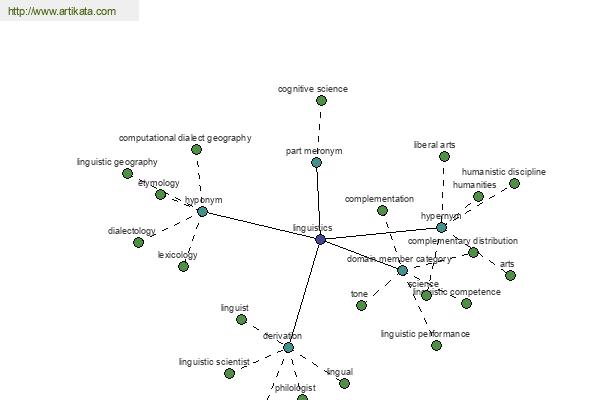 Explore linguistics in ArtiKata.com >