france
English Thesaurus
1. a republic in western Europe; the largest country wholly in Europe (noun.location)
| part holonym | : | maginot line, |
| definition | : | a fortification built before World War II to protect France's eastern border; initially considered to be impregnable, it was easily overrun by the German army in 1940 (noun.artifact) |
| part holonym | : | palace of versailles, versailles, |
| definition | : | a palace built in the 17th century for Louis XIV southwest of Paris near the city of Versailles (noun.artifact) |
| part holonym | : | avignon, |
| definition | : | a town in southeastern France on the Rhone River; the seat of the papacy from 1309 to 1378 and the residence of antipopes during the Great Schism (noun.location) |
| part holonym | : | bordeaux, |
| definition | : | a port city in southwestern France; a major center of the wine trade (noun.location) |
| part holonym | : | brest, |
| definition | : | a port city in northwestern France (in Brittany); the chief naval station of France (noun.location) |
| part holonym | : | calais, |
| definition | : | a town in northern France on the Strait of Dover that serves as a ferry port to England; in 1347 it was captured by the English king Edward III after a long siege and remained in English hands until it was recaptured by the French king Henry II in 1558 (noun.location) |
| part holonym | : | cannes, |
| definition | : | a port and resort city on the French Riviera; site of an annual film festival (noun.location) |
| part holonym | : | chablis, |
| definition | : | a town in north central France noted for white Burgundy wines (noun.location) |
| part holonym | : | chartres, |
| definition | : | a town in northern France that is noted for its Gothic Cathedral (noun.location) |
| part holonym | : | cherbourg, |
| definition | : | a port town in northwestern France on the English Channel; site of a naval base (noun.location) |
| part holonym | : | dijon, |
| definition | : | an industrial city in eastern France to the north of Lyons (noun.location) |
| part holonym | : | grenoble, |
| definition | : | a city in southeastern France on the Isere River (noun.location) |
| part holonym | : | le havre, |
| definition | : | a port city in northern France on the English Channel at the mouth of the Seine (noun.location) |
| part holonym | : | lille, |
| definition | : | an industrial city in northern France near the Belgian border; was the medieval capital of Flanders (noun.location) |
| part holonym | : | lyon, lyons, |
| definition | : | a city in east-central France on the Rhone River; a principal producer of silk and rayon (noun.location) |
| part holonym | : | marseille, marseilles, |
| definition | : | a port city in southeastern France on the Mediterranean (noun.location) |
| part holonym | : | nancy, |
| definition | : | a city in northeastern France in Lorraine (noun.location) |
| part holonym | : | nantes, |
| definition | : | a port city in western France on the Loire estuary (noun.location) |
| part holonym | : | nice, |
| definition | : | a city in southeastern France on the Mediterranean; the leading resort on the French Riviera (noun.location) |
| part holonym | : | orleans, |
| definition | : | a city on the Loire river in north central France; site of the siege of Orleans by the English (1428-1429) (noun.location) |
| part holonym | : | reims, rheims, |
| definition | : | a city in northeastern France to the east of Paris; scene of the coronation of most French kings; site of the unconditional German surrender in 1945 at the end of World War II (noun.location) |
| part holonym | : | toulon, |
| definition | : | a port city and naval base in southeastern France on the Mediterranean coast (noun.location) |
| part holonym | : | toulouse, |
| definition | : | a city on the Garonne River in southern France to the southeast of Bordeaux; a cultural center of medieval Europe (noun.location) |
| part holonym | : | tours, |
| definition | : | an industrial city in western France on the Loire River (noun.location) |
| part holonym | : | valenciennes, |
| definition | : | a town in northeastern France long noted for its lace industry (noun.location) |
| part holonym | : | versailles, |
| definition | : | a city in north central France near Paris; site of the Palace of Versailles that was built by Louis XIV in the 17th century (noun.location) |
| part holonym | : | vichy, |
| definition | : | a town in central France (south of Paris) noted for hot mineral springs; was capital of the unoccupied part of France during World War II (noun.location) |
| part holonym | : | vienne, |
| definition | : | a town in south central France where is 1311-1313 the Roman Catholic Church held one of its councils (noun.location) |
| part holonym | : | riviera, |
| definition | : | a coastal area between La Spezia in Italy and Cannes in France (noun.location) |
| part holonym | : | french region, |
| definition | : | a geographical subdivision of France (noun.location) |
| part holonym | : | alsace, alsatia, elsass, |
| definition | : | a region of northeastern France famous for its wines (noun.location) |
| part holonym | : | anjou, |
| definition | : | a former province of western France in the Loire valley (noun.location) |
| part holonym | : | aquitaine, aquitania, |
| definition | : | a region of southwestern France between Bordeaux and the Pyrenees (noun.location) |
| part holonym | : | artois, |
| definition | : | a former province of northern France near the English Channel (between Picardy and Flanders) (noun.location) |
| part holonym | : | auvergne, |
| definition | : | a region in central France (noun.location) |
| part holonym | : | bourgogne, burgundy, |
| definition | : | a former province of eastern France that is famous for its wines (noun.location) |
| part holonym | : | breiz, bretagne, brittany, |
| definition | : | a former province of northwestern France on a peninsula between the English Channel and the Bay of Biscay (noun.location) |
| part holonym | : | centre, |
| definition | : | a low-lying region in central France (noun.location) |
| part holonym | : | corse, corsica, |
| definition | : | a region of France on the island of Corsica; birthplace of Napoleon Bonaparte (noun.location) |
| part holonym | : | franche-comte, |
| definition | : | a former province of eastern France (noun.location) |
| part holonym | : | gascogne, gascony, |
| definition | : | a region of southwestern France (noun.location) |
| part holonym | : | ile-de-france, |
| definition | : | a region of north central France including Paris and the area around it (noun.location) |
| part holonym | : | languedoc-roussillon, |
| definition | : | a region in south central France; named after the medieval dialect of French that was spoken there (noun.location) |
| part holonym | : | limousin, |
| definition | : | a region of central France to the west of the Auvergne mountains (noun.location) |
| part holonym | : | lorraine, lothringen, |
| definition | : | an eastern French region rich in iron-ore deposits (noun.location) |
| part holonym | : | midi, |
| definition | : | the southern part of France (noun.location) |
| part holonym | : | midi-pyrenees, |
| definition | : | a region in southwestern France (noun.location) |
| part holonym | : | nord-pas-de-calais, |
| definition | : | a region in northeastern France (noun.location) |
| part holonym | : | pays de la loire, |
| definition | : | an agricultural region of western France on the Bay of Biscay (noun.location) |
| part holonym | : | picardie, picardy, |
| definition | : | a region of northern France on the English Channel (noun.location) |
| part holonym | : | poitou, poitou-charentes, |
| definition | : | a low-lying region of west central France on the Bay of Biscay (noun.location) |
| part holonym | : | rhone-alpes, |
| definition | : | a mountainous region of eastern France drained by the Rhone and Saone and Isere rivers (noun.location) |
| part holonym | : | normandie, normandy, |
| definition | : | a former province of northwestern France on the English channel; divided into Haute-Normandie and Basse-Normandie (noun.location) |
| part holonym | : | orleanais, |
| definition | : | a former province of north central France; centered around Orleans (noun.location) |
| part holonym | : | provence, |
| definition | : | a former province of southeastern France; now administered with Cote d'Azur (noun.location) |
| part holonym | : | savoy, |
| definition | : | a geographical region of historical importance; a former duchy in what is now southwestern France, western Switzerland, and northwestern Italy (noun.location) |
| part holonym | : | alps, the alps, |
| definition | : | a large mountain system in south-central Europe; scenic beauty and winter sports make them a popular tourist attraction (noun.object) |
| part holonym | : | garonne, garonne river, |
| definition | : | a river that rises in the Pyrenees and flows northwest to the Bay of Biscay (noun.object) |
| part holonym | : | isere, isere river, |
| definition | : | a river in southeastern France; a tributary of the Rhone (noun.object) |
| part holonym | : | lake geneva, lake leman, |
| definition | : | a lake between southwestern Switzerland and France that is crossed from east to west by the Rhone (noun.object) |
| part holonym | : | lascaux, |
| definition | : | a cave in southwestern France that contains Paleolithic paintings (noun.object) |
| part holonym | : | loire, loire river, |
| definition | : | the longest French river; rises in the Massif Central and flows north and west to the Atlantic Ocean (noun.object) |
| part holonym | : | loire valley, |
| definition | : | the valley of the Loire River where many French wines originated (noun.object) |
| part holonym | : | massif central, |
| definition | : | a mountainous plateau in southern France that covers almost one sixth of the country (noun.object) |
| part holonym | : | meuse, meuse river, |
| definition | : | a European river; flows into the North Sea (noun.object) |
| part holonym | : | mont blanc, monte bianco, |
| definition | : | the highest mountain peak in the Alps; on the border between France and Italy to the south of Geneva (15,781 feet high) (noun.object) |
| part holonym | : | pyrenees, |
| definition | : | a chain of mountains between France and Spain (noun.object) |
| part holonym | : | rhein, rhine, rhine river, |
| definition | : | a major European river carrying more traffic than any other river in the world; flows into the North Sea (noun.object) |
| part holonym | : | rhone, rhone river, |
| definition | : | a major French river; flows into the Mediterranean near Marseilles (noun.object) |
| part holonym | : | sambre, sambre river, |
| definition | : | a river in western Europe that rises in northern France and flows generally east into Belgium where it joins the Meuse at Namur (noun.object) |
| part holonym | : | saone, saone river, |
| definition | : | a river in eastern France; rises in Lorraine and flows south to become the chief tributary of the Rhone (noun.object) |
| part holonym | : | scheldt, scheldt river, |
| definition | : | a river that rises in France and flows northeast across Belgium and empties into the North Sea (noun.object) |
| part holonym | : | seine, seine river, |
| definition | : | a French river that flows through the heart of Paris and then northward into the English Channel (noun.object) |
| part meronym | : | europe, |
| definition | : | the 2nd smallest continent (actually a vast peninsula of Eurasia); the British use `Europe' to refer to all of the continent except the British Isles (noun.object) |
| member holonym | : | basque, |
| definition | : | a member of a people of unknown origin living in the western Pyrenees in France and Spain (noun.person) |
| member meronym | : | nato, north atlantic treaty organization, |
| definition | : | an international organization created in 1949 by the North Atlantic Treaty for purposes of collective security (noun.group) |
| domain member region | : | apache dance, |
| definition | : | a violent fast dance in French vaudeville (an apache is a member of the French underworld) (noun.act) |
| domain member region | : | agincourt, |
| definition | : | a battle in northern France in which English longbowmen under Henry V decisively defeated a much larger French army in 1415 (noun.act) |
| domain member region | : | chalons, chalons-sur-marne, |
| definition | : | the battle in which Attila the Hun was defeated by the Romans and Visigoths in 451 (noun.act) |
| domain member region | : | battle of crecy, crecy, |
| definition | : | the first decisive battle of the Hundred Years' War; in 1346 the English under Edward III defeated the French under Philip of Valois (noun.act) |
| domain member region | : | dunkerque, dunkirk, |
| definition | : | an amphibious evacuation in World War II (1940) when 330,000 Allied troops had to be evacuated from the beaches in northern France in a desperate retreat under enemy fire (noun.act) |
| domain member region | : | battle of ivry, ivry, ivry la bataille, |
| definition | : | a battle (1590) in which the Huguenots under Henry IV defeated the Catholics under the duke of Mayenne (noun.act) |
| domain member region | : | orleans, siege of orleans, |
| definition | : | a long siege of Orleans by the English was relieved by Joan of Arc in 1429 (noun.act) |
| domain member region | : | battle of poitiers, poitiers, |
| definition | : | the battle in 1356 in which the English under the Black Prince defeated the French (noun.act) |
| domain member region | : | battle of rocroi, rocroi, |
| definition | : | a battle in the Thirty Years' War (1643); the French defeated the Spanish invaders (noun.act) |
| domain member region | : | battle of st mihiel, saint-mihiel, st mihiel, |
| definition | : | a battle in the Meuse-Argonne operation in World War I (1918); the battle in which American troops launched their first offensive in France (noun.act) |
| domain member region | : | battle of tertry, tertry, |
| definition | : | a battle in France in 687 among the descendants of Clovis (noun.act) |
| domain member region | : | battle of valmy, valmy, |
| definition | : | the French defeated the Austrian and Prussian troops in 1792 (with a famous cannonade from the French artillery) (noun.act) |
| domain member region | : | battle of verdun, verdun, |
| definition | : | a battle in World War I (1916); in some of the bloodiest fighting in World War I the German offensive was stopped (noun.act) |
| domain member region | : | french revolution, |
| definition | : | the revolution in France against the Bourbons; 1789-1799 (noun.act) |
| domain member region | : | bastille, |
| definition | : | a fortress built in Paris in the 14th century and used as a prison in the 17th and 18th centuries; it was destroyed July 14, 1789 at the start of the French Revolution (noun.artifact) |
| domain member region | : | oriflamme, |
| definition | : | a red or orange-red flag used as a standard by early French kings (noun.artifact) |
| domain member region | : | rue, |
| definition | : | (French) a street or road in France (noun.artifact) |
| domain member region | : | tricolor, tricolour, |
| definition | : | a flag having three colored stripes (especially the French flag) (noun.artifact) |
| domain member region | : | jeu d'esprit, |
| definition | : | a witty comment or writing (noun.communication) |
| domain member region | : | bon mot, mot, |
| definition | : | a clever remark (noun.communication) |
| domain member region | : | french, |
| definition | : | the Romance language spoken in France and in countries colonized by France (noun.communication) |
| domain member region | : | bonheur, |
| definition | : | (French) happiness and good humor (noun.feeling) |
| domain member region | : | haute cuisine, |
| definition | : | (French) an elaborate and skillful manner of preparing food (noun.food) |
| domain member region | : | nouvelle cuisine, |
| definition | : | a school of French cooking that uses light sauces and tries to bring out the natural flavors of foods instead of making heavy use of butter and cream (noun.food) |
| domain member region | : | bureau de change, |
| definition | : | (French) an establishment where you can exchange foreign money (noun.group) |
| domain member region | : | flnc, national liberation front of corsica, |
| definition | : | a terrorist group formed in 1976 to work for Corsican independence; attacks on Corsica are aimed at sabotaging public infrastructure and symbols of colonialism (noun.group) |
| domain member region | : | ancien regime, |
| definition | : | a political and social system that no longer governs (especially the system that existed in France before the French Revolution) (noun.group) |
| domain member region | : | estate, estate of the realm, the three estates, |
| definition | : | a major social class or order of persons regarded collectively as part of the body politic of the country (especially in the United Kingdom) and formerly possessing distinct political rights (noun.group) |
| domain member region | : | first estate, lords spiritual, |
| definition | : | the clergy in France and the heads of the church in Britain (noun.group) |
| domain member region | : | escadrille, |
| definition | : | an air force squadron typically containing six airplanes (as in France during World War I) (noun.group) |
| domain member region | : | noblesse, |
| definition | : | members of the nobility (especially of the French nobility) (noun.group) |
| domain member region | : | commune, |
| definition | : | the smallest administrative district of several European countries (noun.location) |
| domain member region | : | department, |
| definition | : | the territorial and administrative division of some countries (such as France) (noun.location) |
| domain member region | : | prefecture, |
| definition | : | the district administered by a prefect (as in France or Japan or the Roman Empire) (noun.location) |
| domain member region | : | deputy, |
| definition | : | a member of the lower chamber of a legislative assembly (such as in France) (noun.person) |
| domain member region | : | franc-tireur, |
| definition | : | a sharpshooter (in the French army) (noun.person) |
| domain member region | : | legionary, legionnaire, |
| definition | : | a soldier who is a member of a legion (especially the French Foreign Legion) (noun.person) |
| domain member region | : | patron, |
| definition | : | the proprietor of an inn (noun.person) |
| domain member region | : | quadrillion, |
| definition | : | the number that is represented as a one followed by 15 zeros (noun.quantity) |
| domain member region | : | quintillion, |
| definition | : | the number that is represented as a one followed by 18 zeros (noun.quantity) |
| domain member region | : | sextillion, |
| definition | : | the number that is represented as a one followed by 21 zeros (noun.quantity) |
| domain member region | : | septillion, |
| definition | : | the number that is represented as a one followed by 24 zeros (noun.quantity) |
| domain member region | : | octillion, |
| definition | : | the number that is represented as a one followed by 27 zeros (noun.quantity) |
2. French writer of sophisticated novels and short stories (1844-1924) (noun.person)
| instance hypernym | : | author, writer, |
| definition | : | writes (books or stories or articles or the like) professionally (for pay) (noun.person) |
Visual ArtiKata
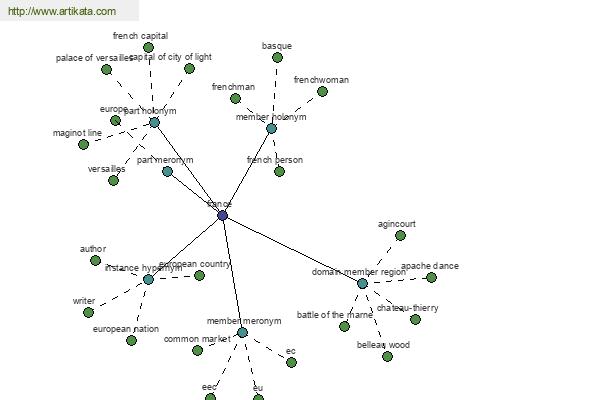 Explore france in ArtiKata.com >