defence
English Thesaurus
1. the act of defending someone or something against attack or injury (noun.act)
| hypernym | : | protection, protection, |
| definition | : | the activity of protecting someone or something (noun.act) |
2. (military) military action or resources protecting a country against potential enemies (noun.act)
| hyponym | : | umbrella, |
| definition | : | a formation of military planes maintained over ground operations or targets (noun.act) |
| hyponym | : | air defense, |
| definition | : | defensive measures designed to destroy attacking enemy aircraft or missiles or to nullify their effectiveness (noun.act) |
| hyponym | : | stand, |
| definition | : | a defensive effort (noun.act) |
| hyponym | : | hasty defence, hasty defense, |
| definition | : | a defense organized while in contact with the enemy or when time is limited (noun.act) |
| hyponym | : | deliberate defence, deliberate defense, |
| definition | : | a defense organized before contact is made with the enemy and while time for organization is available; usually includes a fortified zone (with pillboxes) and communication systems (noun.act) |
| hyponym | : | minelaying, mining, |
| definition | : | laying explosive mines in concealed places to destroy enemy personnel and equipment (noun.act) |
3. a defendant's answer or plea denying the truth of the charges against him (noun.act)
| hypernym | : | due process, due process of law, |
| definition | : | (law) the administration of justice according to established rules and principles; based on the principle that a person cannot be deprived of life or liberty or property without appropriate legal procedures and safeguards (noun.act) |
| hyponym | : | entrapment, |
| definition | : | a defense that claims the defendant would not have broken the law if not tricked into doing it by law enforcement officials (noun.act) |
| part meronym | : | trial, |
| definition | : | (law) the determination of a person's innocence or guilt by due process of law (noun.act) |
| domain category | : | jurisprudence, law, |
| definition | : | the collection of rules imposed by authority (noun.group) |
4. a structure used to defend against attack (noun.artifact)
| hypernym | : | construction, structure, |
| definition | : | a thing constructed; a complex entity constructed of many parts (noun.artifact) |
| hyponym | : | cheval-de-frise, chevaux-de-frise, |
| definition | : | defensive structure consisting of a movable obstacle composed of barbed wire or spikes attached to a wooden frame; used to obstruct cavalry (noun.artifact) |
| hyponym | : | fortification, munition, |
| definition | : | defensive structure consisting of walls or mounds built around a stronghold to strengthen it (noun.artifact) |
| hyponym | : | fort, fortress, |
| definition | : | a fortified defensive structure (noun.artifact) |
| hyponym | : | line of defence, line of defense, |
| definition | : | defensive structure consisting of a barrier that can be employed for defense against attack (noun.artifact) |
| hyponym | : | outwork, |
| definition | : | subsidiary defensive structure lying outside the main fortified area (noun.artifact) |
| hyponym | : | fastness, stronghold, |
| definition | : | a strongly fortified defensive structure (noun.artifact) |
5. the justification for some act or belief (noun.communication)
| hypernym | : | justification, |
| definition | : | a statement in explanation of some action or belief (noun.communication) |
| hyponym | : | apologia, apology, |
| definition | : | a formal written defense of something you believe in strongly (noun.communication) |
| hyponym | : | alibi, |
| definition | : | (law) a defense by an accused person purporting to show that he or she could not have committed the crime in question (noun.communication) |
6. the speech act of answering an attack on your assertions (noun.communication)
| hypernym | : | answer, |
| definition | : | the speech act of replying to a question (noun.communication) |
| hyponym | : | confutation, |
| definition | : | the speech act of refuting conclusively (noun.communication) |
| hyponym | : | rebuttal, |
| definition | : | the speech act of refuting by offering a contrary contention or argument (noun.communication) |
7. an organization of defenders that provides resistance against attack (noun.group)
| hyponym | : | bastion, |
| definition | : | a group that defends a principle (noun.group) |
8. the defendant and his legal advisors collectively (noun.group)
9. (sports) the team that is trying to prevent the other team from scoring (noun.group)
| hypernym | : | squad, team, |
| definition | : | a cooperative unit (especially in sports) (noun.group) |
| domain category | : | athletics, sport, |
| definition | : | an active diversion requiring physical exertion and competition (noun.act) |
10. (psychiatry) an unconscious process that tries to reduce the anxiety associated with instinctive desires (noun.process)
| hypernym | : | psychoanalytic process, |
| definition | : | a process that is assumed to occur in psychoanalytic theory (noun.process) |
| hyponym | : | compensation, |
| definition | : | (psychiatry) a defense mechanism that conceals your undesirable shortcomings by exaggerating desirable behaviors (noun.process) |
| hyponym | : | conversion, |
| definition | : | (psychiatry) a defense mechanism represses emotional conflicts which are then converted into physical symptoms that have no organic basis (noun.process) |
| hyponym | : | denial, |
| definition | : | (psychiatry) a defense mechanism that denies painful thoughts (noun.process) |
| hyponym | : | displacement, |
| definition | : | (psychiatry) a defense mechanism that transfers affect or reaction from the original object to some more acceptable one (noun.process) |
| hyponym | : | idealisation, idealization, |
| definition | : | (psychiatry) a defense mechanism that splits something you are ambivalent about into two representations--one good and one bad (noun.process) |
| hyponym | : | isolation, |
| definition | : | (psychiatry) a defense mechanism in which memory of an unacceptable act or impulse is separated from the emotion originally associated with it (noun.process) |
| hyponym | : | projection, |
| definition | : | (psychiatry) a defense mechanism by which your own traits and emotions are attributed to someone else (noun.process) |
| hyponym | : | rationalisation, rationalization, |
| definition | : | (psychiatry) a defense mechanism by which your true motivation is concealed by explaining your actions and feelings in a way that is not threatening (noun.process) |
| hyponym | : | reaction formation, |
| definition | : | (psychiatry) a defense mechanism in which a person unconsciously develops attitudes and behavior that are the opposite of unacceptable repressed desires and impulses and serve to conceal them (noun.process) |
| hyponym | : | regression, |
| definition | : | (psychiatry) a defense mechanism in which you flee from reality by assuming a more infantile state (noun.process) |
| hyponym | : | repression, |
| definition | : | (psychiatry) the classical defense mechanism that protects you from impulses or ideas that would cause anxiety by preventing them from becoming conscious (noun.process) |
11. a defendant's answer or plea denying the truth of the charges against him (noun.act)
| antonym | : | criminal prosecution, prosecution, |
| definition | : | the institution and conduct of legal proceedings against a defendant for criminal behavior (noun.act) |
| derivation | : | deny, traverse, |
| definition | : | deny formally (an allegation of fact by the opposing party) in a legal suit (verb.communication) |
12. the justification for some act or belief (noun.communication)
| derivation | : | justify, vindicate, |
| definition | : | show to be right by providing justification or proof (verb.communication) |
| derivation | : | vindicate, |
| definition | : | maintain, uphold, or defend (verb.communication) |
13. the speech act of answering an attack on your assertions (noun.communication)
| derivation | : | rebut, refute, |
| definition | : | overthrow by argument, evidence, or proof (verb.communication) |
14. an organization of defenders that provides resistance against attack (noun.group)
| derivation | : | defend, guard, hold, |
| definition | : | protect against a challenge or attack (verb.competition) |
15. the defendant and his legal advisors collectively (noun.group)
| antonym | : | prosecution, |
| definition | : | the lawyers acting for the state to put the case against the defendant (noun.group) |
| derivation | : | defend, represent, |
| definition | : | be the defense counsel for someone in a trial (verb.social) |
16. (sports) the team that is trying to prevent the other team from scoring (noun.group)
| antonym | : | offence, offense, |
| definition | : | the team that has the ball (or puck) and is trying to score (noun.group) |
| derivation | : | defend, |
| definition | : | be on the defensive; act against an attack (verb.competition) |
17. a defendant's answer or plea denying the truth of the charges against him (noun.act)
| antonym | : | criminal prosecution, prosecution, |
| definition | : | the institution and conduct of legal proceedings against a defendant for criminal behavior (noun.act) |
| derivation | : | deny, traverse, |
| definition | : | deny formally (an allegation of fact by the opposing party) in a legal suit (verb.communication) |
18. the justification for some act or belief (noun.communication)
| derivation | : | justify, vindicate, |
| definition | : | show to be right by providing justification or proof (verb.communication) |
| derivation | : | vindicate, |
| definition | : | maintain, uphold, or defend (verb.communication) |
19. the speech act of answering an attack on your assertions (noun.communication)
| derivation | : | rebut, refute, |
| definition | : | overthrow by argument, evidence, or proof (verb.communication) |
20. an organization of defenders that provides resistance against attack (noun.group)
| derivation | : | defend, guard, hold, |
| definition | : | protect against a challenge or attack (verb.competition) |
21. the defendant and his legal advisors collectively (noun.group)
| antonym | : | prosecution, |
| definition | : | the lawyers acting for the state to put the case against the defendant (noun.group) |
| derivation | : | defend, represent, |
| definition | : | be the defense counsel for someone in a trial (verb.social) |
22. (sports) the team that is trying to prevent the other team from scoring (noun.group)
| antonym | : | offence, offense, |
| definition | : | the team that has the ball (or puck) and is trying to score (noun.group) |
| derivation | : | defend, |
| definition | : | be on the defensive; act against an attack (verb.competition) |
Visual ArtiKata
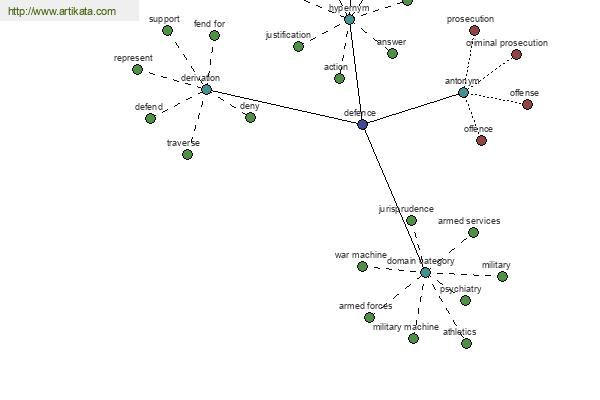 Explore defence in ArtiKata.com >