chemical compound
English Thesaurus
1. (chemistry) a substance formed by chemical union of two or more elements or ingredients in definite proportion by weight (noun.substance)
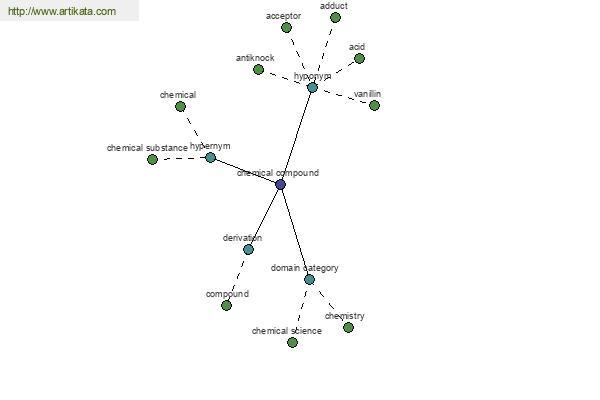
| hypernym | : | chemical, chemical substance, |
| definition | : | material produced by or used in a reaction involving changes in atoms or molecules (noun.substance) |
| hyponym | : | vanillin, |
| definition | : | a crystalline compound found in vanilla beans and some balsam resins; used in perfumes and flavorings (noun.plant) |
| hyponym | : | acceptor, |
| definition | : | (chemistry) in the formation of a coordinate bond it is the compound to which electrons are donated (noun.substance) |
| hyponym | : | adduct, |
| definition | : | a compound formed by an addition reaction (noun.substance) |
| hyponym | : | antiknock, |
| definition | : | any of various compounds that are added to gasoline to reduce engine knocking (noun.substance) |
| hyponym | : | acid, |
| definition | : | any of various water-soluble compounds having a sour taste and capable of turning litmus red and reacting with a base to form a salt (noun.substance) |
| hyponym | : | arsenide, |
| definition | : | a compound of arsenic with a more positive element (noun.substance) |
| hyponym | : | hydrogen cyanide, |
| definition | : | a highly poisonous gas or volatile liquid that smells like bitter almonds; becomes a gas at around 90 degree Fahrenheit and is most dangerous when inhaled; the anhydride of hydrocyanic acid; used in manufacturing (noun.substance) |
| hyponym | : | anionic compound, |
| definition | : | a compound characterized by an active anion (noun.substance) |
| hyponym | : | alkali, base, |
| definition | : | any of various water-soluble compounds capable of turning litmus blue and reacting with an acid to form a salt and water (noun.substance) |
| hyponym | : | binary compound, |
| definition | : | chemical compound composed of only two elements (noun.substance) |
| hyponym | : | taurine, |
| definition | : | a colorless crystalline substance obtained from the bile of mammals (noun.substance) |
| hyponym | : | chromogen, |
| definition | : | a compound that can be converted to a pigment (noun.substance) |
| hyponym | : | manganese tetroxide, |
| definition | : | an oxide of manganese found naturally as hausmannite (noun.substance) |
| hyponym | : | monomer, |
| definition | : | a simple compound whose molecules can join together to form polymers (noun.substance) |
| hyponym | : | ozonide, |
| definition | : | any of a class of unstable chemical compounds resulting from the addition of ozone to a double bond in an unsaturated compound (noun.substance) |
| hyponym | : | organic compound, |
| definition | : | any compound of carbon and another element or a radical (noun.substance) |
| hyponym | : | ammine, |
| definition | : | a complex inorganic compound that contains ammonia molecules (noun.substance) |
| hyponym | : | anhydride, |
| definition | : | a compound formed from one or more other compounds in a reaction resulting in removal of water (noun.substance) |
| hyponym | : | azide, |
| definition | : | a chemical compound containing the azido group combined with an element or radical (noun.substance) |
| hyponym | : | bitter principle, |
| definition | : | any one of several hundred compounds having a bitter taste; not admitting of chemical classification (noun.substance) |
| hyponym | : | buffer, |
| definition | : | (chemistry) an ionic compound that resists changes in its pH (noun.substance) |
| hyponym | : | calcium-cyanamide, cyanamide, |
| definition | : | a compound used as a fertilizer and as a source of nitrogen compounds (noun.substance) |
| hyponym | : | carbonyl, |
| definition | : | a compound containing metal combined with carbon monoxide (noun.substance) |
| hyponym | : | carbon disulfide, |
| definition | : | a toxic colorless flammable liquid (CS2); used in the manufacture of rayon and cellophane and carbon tetrachloride and as a solvent for rubber (noun.substance) |
| hyponym | : | cofactor, |
| definition | : | a substance (as a coenzyme) that must join with another to produce a given result (noun.substance) |
| hyponym | : | cementite, iron carbide, |
| definition | : | a chemical compound that is a constituent of steel and cast iron; very hard and brittle (noun.substance) |
| hyponym | : | chloropicrin, nitrochloroform, |
| definition | : | a heavy colorless insoluble liquid compound that causes tears and vomiting; used as a pesticide and as tear gas (noun.substance) |
| hyponym | : | complex, coordination compound, |
| definition | : | a compound described in terms of the central atom to which other atoms are bound or coordinated (noun.substance) |
| hyponym | : | allomorph, |
| definition | : | any of several different crystalline forms of the same chemical compound (noun.substance) |
| hyponym | : | corrosive, |
| definition | : | a substance having the tendency to cause corrosion (such a strong acids or alkali) (noun.substance) |
| hyponym | : | aluminate, |
| definition | : | a compound of alumina and a metallic oxide (noun.substance) |
| hyponym | : | defoliant, |
| definition | : | a chemical that is sprayed on plants and causes their leaves to fall off (noun.substance) |
| hyponym | : | depilatory, |
| definition | : | a chemical (usually a sulfide) used to remove hair or wool or bristles from hides (noun.substance) |
| hyponym | : | derivative, |
| definition | : | a compound obtained from, or regarded as derived from, another compound (noun.substance) |
| hyponym | : | dimer, |
| definition | : | a compound whose molecules are composed of two identical monomers (noun.substance) |
| hyponym | : | fixer, fixing agent, |
| definition | : | a chemical compound that sets or fixes something (as a dye or a photographic image) (noun.substance) |
| hyponym | : | flavone, |
| definition | : | a colorless crystalline compound that is part of a number of white or yellow plant pigments (noun.substance) |
| hyponym | : | enantiomer, enantiomorph, |
| definition | : | either one of a pair of compounds (crystals or molecules) that are mirror images on each other but are not identical (noun.substance) |
| hyponym | : | exotherm, |
| definition | : | a compound that gives off heat during its formation and absorbs heat during its decomposition (noun.substance) |
| hyponym | : | goitrogen, |
| definition | : | any substance (such as thiouracil) that induces the formation of a goiter (noun.substance) |
| hyponym | : | benzofuran, coumarone, cumarone, |
| definition | : | a colorless oily compound extracted from coal tar and used in manufacturing synthetic resins (noun.substance) |
| hyponym | : | hydrate, |
| definition | : | any compound that contains water of crystallization (noun.substance) |
| hyponym | : | hydroxide, |
| definition | : | a chemical compound containing the hydroxyl group (noun.substance) |
| hyponym | : | incense, |
| definition | : | a substance that produces a fragrant odor when burned (noun.substance) |
| hyponym | : | inorganic compound, |
| definition | : | any compound that does not contain carbon (noun.substance) |
| hyponym | : | repellant, repellent, |
| definition | : | a chemical substance that repels animals (noun.substance) |
| hyponym | : | repellant, repellent, |
| definition | : | a compound with which fabrics are treated to repel water (noun.substance) |
| hyponym | : | iodocompound, |
| definition | : | a compound containing the covalent iodine radical (noun.substance) |
| hyponym | : | isomer, |
| definition | : | a compound that exists in forms having different arrangements of atoms but the same molecular weight (noun.substance) |
| hyponym | : | menthol, |
| definition | : | a crystalline compound that has the cool and minty taste and odor that occurs naturally in peppermint oil; used as a flavoring and in medicine to relieve itching, pain, and nasal congestion (noun.substance) |
| hyponym | : | nitrogen mustard, |
| definition | : | a toxic compound resembling mustard gas in structure; important in cancer treatment (noun.substance) |
| hyponym | : | nitride, |
| definition | : | a compound containing nitrogen and a more electropositive element (such as phosphorus or a metal) (noun.substance) |
| hyponym | : | oxide, |
| definition | : | any compound of oxygen with another element or a radical (noun.substance) |
| hyponym | : | polymer, |
| definition | : | a naturally occurring or synthetic compound consisting of large molecules made up of a linked series of repeated simple monomers (noun.substance) |
| hyponym | : | preservative, |
| definition | : | a chemical compound that is added to protect against decay or decomposition (noun.substance) |
| hyponym | : | benzoquinone, quinone, |
| definition | : | any of a class of aromatic yellow compounds including several that are biologically important as coenzymes or acceptors or vitamins; used in making dyes (noun.substance) |
| hyponym | : | salt, |
| definition | : | a compound formed by replacing hydrogen in an acid by a metal (or a radical that acts like a metal) (noun.substance) |
| hyponym | : | caustic, |
| definition | : | any chemical substance that burns or destroys living tissue (noun.substance) |
| hyponym | : | nitrate, |
| definition | : | any compound containing the nitrate group (such as a salt or ester of nitric acid) (noun.substance) |
| hyponym | : | chloride, |
| definition | : | any compound containing a chlorine atom (noun.substance) |
| hyponym | : | silicide, |
| definition | : | any of various compounds of silicon with a more electropositive element or radical (noun.substance) |
| hyponym | : | siloxane, |
| definition | : | any of a large class of compounds that have alternate silicon and oxygen atoms (noun.substance) |
| hyponym | : | solvate, |
| definition | : | a compound formed by solvation (the combination of solvent molecules with molecules or ions of the solute) (noun.substance) |
| hyponym | : | sternutator, sternutatory, |
| definition | : | a chemical substance that causes sneezing and coughing and crying (noun.substance) |
| hyponym | : | stripper, |
| definition | : | a chemical compound used to remove paint or varnish (noun.substance) |
| hyponym | : | sulfide, sulphide, |
| definition | : | a compound of sulphur and some other element that is more electropositive (noun.substance) |
| hyponym | : | telluride, |
| definition | : | any binary compound of tellurium with other more electropositive elements (noun.substance) |
| hyponym | : | tenderiser, tenderizer, |
| definition | : | a substance (as the plant enzyme papain) applied to meat to make it tender (noun.substance) |
| hyponym | : | tetrachloride, |
| definition | : | any compound that contains four chlorine atoms per molecule (noun.substance) |
| hyponym | : | triazine, |
| definition | : | any of three isomeric compounds having three carbon and three nitrogen atoms in a six-membered ring (noun.substance) |
| hyponym | : | u308, yellowcake, |
| definition | : | an impure mixture of uranium oxides obtained during the processing of uranium ore (noun.substance) |
| hyponym | : | enamel, |
| definition | : | a colored glassy compound (opaque or partially opaque) that is fused to the surface of metal or glass or pottery for decoration or protection (noun.substance) |
| hyponym | : | pregnanediol, |
| definition | : | a compound found in women's urine during certain phases of the menstrual cycle and in the urine of pregnant women (noun.substance) |
| domain category | : | chemical science, chemistry, |
| definition | : | the science of matter; the branch of the natural sciences dealing with the composition of substances and their properties and reactions (noun.cognition) |
| derivation | : | compound, |
| definition | : | create by mixing or combining (verb.creation) |
| derivation | : | compound, |
| definition | : | create by mixing or combining (verb.creation) |
Visual ArtiKata
 Explore chemical compound in ArtiKata.com >