biological science
English Thesaurus
1. the science that studies living organisms (noun.cognition)
| hypernym | : | bioscience, life science, |
| definition | : | any of the branches of natural science dealing with the structure and behavior of living organisms (noun.cognition) |
| hyponym | : | biogeography, |
| definition | : | dealing with the geographical distribution of animals and plants (noun.cognition) |
| hyponym | : | botany, phytology, |
| definition | : | the branch of biology that studies plants (noun.cognition) |
| hyponym | : | cryobiology, |
| definition | : | the branch of biology that studies the effects of low temperatures on living tissues or organs or organisms (noun.cognition) |
| hyponym | : | cytology, |
| definition | : | the branch of biology that studies the structure and function of cells (noun.cognition) |
| hyponym | : | embryology, |
| definition | : | the branch of biology that studies the formation and early development of living organisms (noun.cognition) |
| hyponym | : | astrobiology, exobiology, space biology, |
| definition | : | the branch of biology concerned with the effects of outer space on living organisms and the search for extraterrestrial life (noun.cognition) |
| hyponym | : | forestry, |
| definition | : | the science of planting and caring for forests and the management of growing timber (noun.cognition) |
| hyponym | : | genetic science, genetics, |
| definition | : | the branch of biology that studies heredity and variation in organisms (noun.cognition) |
| hyponym | : | microbiology, |
| definition | : | the branch of biology that studies microorganisms and their effects on humans (noun.cognition) |
| hyponym | : | molecular biology, |
| definition | : | the branch of biology that studies the structure and activity of macromolecules essential to life (and especially with their genetic role) (noun.cognition) |
| hyponym | : | morphology, |
| definition | : | the branch of biology that deals with the structure of animals and plants (noun.cognition) |
| hyponym | : | neurobiology, |
| definition | : | the branch of biology that deals with the anatomy and physiology and pathology of the nervous system (noun.cognition) |
| hyponym | : | palaeobiology, paleobiology, |
| definition | : | a branch of paleontology that deals with the origin and growth and structure of fossil animals and plants as living organisms (noun.cognition) |
| hyponym | : | physiology, |
| definition | : | the branch of the biological sciences dealing with the functioning of organisms (noun.cognition) |
| hyponym | : | radiobiology, |
| definition | : | the branch of biology that studies the effects of radiation on living organisms (noun.cognition) |
| hyponym | : | sociobiology, |
| definition | : | the branch of biology that conducts comparative studies of the social organization of animals (including human beings) with regard to its evolutionary history (noun.cognition) |
| domain member category | : | cell, |
| definition | : | (biology) the basic structural and functional unit of all organisms; they may exist as independent units of life (as in monads) or may form colonies or tissues as in higher plants and animals (noun.tops) |
| domain member category | : | culture, |
| definition | : | (biology) the growing of microorganisms in a nutrient medium (such as gelatin or agar) (noun.act) |
| domain member category | : | monad, |
| definition | : | (biology) a single-celled microorganism (especially a flagellate protozoan) (noun.animal) |
| domain member category | : | homogeny, |
| definition | : | (biology) similarity because of common evolution (noun.attribute) |
| domain member category | : | isomorphism, isomorphy, |
| definition | : | (biology) similarity or identity of form or shape or structure (noun.attribute) |
| domain member category | : | heterology, |
| definition | : | (biology) the lack of correspondence of apparently similar body parts (noun.attribute) |
| domain member category | : | valence, valency, |
| definition | : | (biology) a relative capacity to unite or react or interact as with antigens or a biological substrate (noun.attribute) |
| domain member category | : | coarctation, |
| definition | : | (biology) a narrowing or constriction of a vessel or canal; especially a congenital narrowing of the aorta (noun.attribute) |
| domain member category | : | spindle, |
| definition | : | (biology) tiny fibers that are seen in cell division; the fibers radiate from two poles and meet at the equator in the middle (noun.body) |
| domain member category | : | meme, |
| definition | : | a cultural unit (an idea or value or pattern of behavior) that is passed from one person to another by non-genetic means (as by imitation) (noun.cognition) |
| domain member category | : | cell doctrine, cell theory, |
| definition | : | (biology) the theory that cells form the fundamental structural and functional units of all living organisms; proposed in 1838 by Matthias Schleiden and by Theodor Schwann (noun.cognition) |
| domain member category | : | theory of inheritance, |
| definition | : | (biology) a theory of how characteristics of one generation are derived from earlier generations (noun.cognition) |
| domain member category | : | cybernetics, |
| definition | : | (biology) the field of science concerned with processes of communication and control (especially the comparison of these processes in biological and artificial systems) (noun.cognition) |
| domain member category | : | taxonomy, |
| definition | : | (biology) study of the general principles of scientific classification (noun.cognition) |
| domain member category | : | cataplasia, |
| definition | : | (biology) degenerative reversion of cells or tissue to a less differentiated or more primitive form (noun.event) |
| domain member category | : | subkingdom, |
| definition | : | (biology) a taxonomic group comprising a major division of a kingdom (noun.group) |
| domain member category | : | variety, |
| definition | : | (biology) a taxonomic category consisting of members of a species that differ from others of the same species in minor but heritable characteristics (noun.group) |
| domain member category | : | phylum, |
| definition | : | (biology) the major taxonomic group of animals and plants; contains classes (noun.group) |
| domain member category | : | subphylum, |
| definition | : | (biology) a taxonomic group ranking between a phylum and a class (noun.group) |
| domain member category | : | superphylum, |
| definition | : | (biology) a taxonomic group ranking between a phylum and below a class or subclass (noun.group) |
| domain member category | : | class, |
| definition | : | (biology) a taxonomic group containing one or more orders (noun.group) |
| domain member category | : | subclass, |
| definition | : | (biology) a taxonomic category below a class and above an order (noun.group) |
| domain member category | : | superclass, |
| definition | : | (biology) a taxonomic class below a phylum and above a class (noun.group) |
| domain member category | : | order, |
| definition | : | (biology) taxonomic group containing one or more families (noun.group) |
| domain member category | : | suborder, |
| definition | : | (biology) taxonomic group that is a subdivision of an order (noun.group) |
| domain member category | : | superorder, |
| definition | : | (biology) a taxonomic group ranking above an order and below a class or subclass (noun.group) |
| domain member category | : | family, |
| definition | : | (biology) a taxonomic group containing one or more genera (noun.group) |
| domain member category | : | superfamily, |
| definition | : | (biology) a taxonomic group ranking below an order but above a family (noun.group) |
| domain member category | : | form family, |
| definition | : | (biology) an artificial taxonomic category for organisms of which the true relationships are obscure (noun.group) |
| domain member category | : | subfamily, |
| definition | : | (biology) a taxonomic category below a family (noun.group) |
| domain member category | : | tribe, |
| definition | : | (biology) a taxonomic category between a genus and a subfamily (noun.group) |
| domain member category | : | genus, |
| definition | : | (biology) taxonomic group containing one or more species (noun.group) |
| domain member category | : | subgenus, |
| definition | : | (biology) taxonomic group between a genus and a species (noun.group) |
| domain member category | : | monotype, |
| definition | : | (biology) a taxonomic group with a single member (a single species or genus) (noun.group) |
| domain member category | : | type genus, |
| definition | : | (biology) genus from which the name of a family or subfamily is formed; it is not necessarily the most representative genus but often the largest or best known or earliest described (noun.group) |
| domain member category | : | form genus, |
| definition | : | (biology) an artificial taxonomic category for organisms of which the true relationships are obscure (noun.group) |
| domain member category | : | species, |
| definition | : | (biology) taxonomic group whose members can interbreed (noun.group) |
| domain member category | : | race, subspecies, |
| definition | : | (biology) a taxonomic group that is a division of a species; usually arises as a consequence of geographical isolation within a species (noun.group) |
| domain member category | : | form, strain, var., variant, |
| definition | : | (biology) a group of organisms within a species that differ in trivial ways from similar groups (noun.group) |
| domain member category | : | type, |
| definition | : | (biology) the taxonomic group whose characteristics are used to define the next higher taxon (noun.group) |
| domain member category | : | type species, |
| definition | : | (biology) the species that best exemplifies the essential characteristics of the genus to which it belongs (noun.group) |
| domain member category | : | division, |
| definition | : | (biology) a group of organisms forming a subdivision of a larger category (noun.group) |
| domain member category | : | biologist, life scientist, |
| definition | : | (biology) a scientist who studies living organisms (noun.person) |
| domain member category | : | mutant, mutation, sport, variation, |
| definition | : | (biology) an organism that has characteristics resulting from chromosomal alteration (noun.person) |
| domain member category | : | organic phenomenon, |
| definition | : | (biology) a natural phenomenon involving living plants and animals (noun.phenomenon) |
| domain member category | : | dehiscence, |
| definition | : | (biology) release of material by splitting open of an organ or tissue; the natural bursting open at maturity of a fruit or other reproductive body to release seeds or spores or the bursting open of a surgically closed wound (noun.phenomenon) |
| domain member category | : | pleomorphism, |
| definition | : | (biology) the appearance of two or more distinctly different forms in the life cycle of some organisms (noun.phenomenon) |
| domain member category | : | polymorphism, |
| definition | : | (biology) the existence of two or more forms of individuals within the same animal species (independent of sex differences) (noun.phenomenon) |
| domain member category | : | dimorphism, |
| definition | : | (biology) the existence of two forms of individual within the same animal species (independent of sex differences) (noun.phenomenon) |
| domain member category | : | recognition, |
| definition | : | (biology) the ability of one molecule to attach to another molecule that has a complementary shape (noun.phenomenon) |
| domain member category | : | elan vital, life force, vital force, vitality, |
| definition | : | (biology) a hypothetical force (not physical or chemical) once thought by Henri Bergson to cause the evolution and development of organisms (noun.phenomenon) |
| domain member category | : | accretion, |
| definition | : | (biology) growth by addition as by the adhesion of parts or particles (noun.process) |
| domain member category | : | anisogamy, |
| definition | : | (biology) reproduction by the union or fusion of two differing gametes (especially differing in size) (noun.process) |
| domain member category | : | apposition, |
| definition | : | (biology) growth in the thickness of a cell wall by the deposit of successive layers of material (noun.process) |
| domain member category | : | development, growing, growth, maturation, ontogenesis, ontogeny, |
| definition | : | (biology) the process of an individual organism growing organically; a purely biological unfolding of events involved in an organism changing gradually from a simple to a more complex level (noun.process) |
| domain member category | : | intussusception, |
| definition | : | (biology) growth in the surface area of a cell by the deposit of new particles between existing particles in the cell wall (noun.process) |
| domain member category | : | isogamy, |
| definition | : | (biology) reproduction by the union or fusion of gametes of the same size and structure (noun.process) |
| domain member category | : | osmosis, |
| definition | : | (biology, chemistry) diffusion of molecules through a semipermeable membrane from a place of higher concentration to a place of lower concentration until the concentration on both sides is equal (noun.process) |
| domain member category | : | regeneration, |
| definition | : | (biology) growth anew of lost tissue or destroyed parts or organs (noun.process) |
| domain member category | : | reproduction, |
| definition | : | the process of generating offspring (noun.process) |
| domain member category | : | affinity, phylogenetic relation, |
| definition | : | (biology) state of relationship between organisms or groups of organisms resulting in resemblance in structure or structural parts (noun.linkdef) |
| domain member category | : | uncus, |
| definition | : | (biology) any hook-shaped process or part (noun.shape) |
| domain member category | : | brachium, |
| definition | : | (biology) a branching or armlike part of an animal (noun.shape) |
| domain member category | : | turgor, |
| definition | : | (biology) the normal rigid state of fullness of a cell or blood vessel or capillary resulting from pressure of the contents against the wall or membrane (noun.state) |
| domain member category | : | activator, |
| definition | : | (biology) any agency bringing about activation; a molecule that increases the activity of an enzyme or a protein that increases the production of a gene product in DNA transcription (noun.substance) |
| domain member category | : | medium, |
| definition | : | (biology) a substance in which specimens are preserved or displayed (noun.substance) |
| domain member category | : | multiply, procreate, reproduce, |
| definition | : | have offspring or produce more individuals of a given animal or plant (verb.body) |
| domain member category | : | propagate, |
| definition | : | multiply sexually or asexually (verb.body) |
| domain member category | : | vegetate, |
| definition | : | propagate asexually (verb.body) |
| domain member category | : | enucleate, |
| definition | : | remove the nucleus from (a cell) (verb.change) |
| domain member category | : | transform, |
| definition | : | change (a bacterial cell) into a genetically distinct cell by the introduction of DNA from another cell of the same or closely related species (verb.change) |
| domain member category | : | conjugate, |
| definition | : | undergo conjugation (verb.change) |
| domain member category | : | copy, replicate, |
| definition | : | reproduce or make an exact copy of (verb.creation) |
| domain member category | : | inhibit, |
| definition | : | limit, block, or decrease the action or function of (verb.social) |
| domain member category | : | abaxial, dorsal, |
| definition | : | facing away from the axis of an organ or organism (adj.all) |
| domain member category | : | adaxial, ventral, |
| definition | : | nearest to or facing toward the axis of an organ or organism (adj.all) |
| domain member category | : | antrorse, |
| definition | : | bent or curved forward or upward (adj.all) |
| domain member category | : | retrorse, |
| definition | : | bent or curved backward or downward (adj.all) |
| domain member category | : | semiaquatic, subaquatic, |
| definition | : | partially aquatic; living or growing partly on land and partly in water (adj.all) |
| domain member category | : | amphibiotic, semiaquatic, |
| definition | : | having an aquatic early or larval form and a terrestrial adult form (adj.all) |
| domain member category | : | sessile, stalkless, |
| definition | : | attached directly by the base; not having an intervening stalk (adj.all) |
| domain member category | : | pedunculate, stalked, |
| definition | : | having or growing on or from a peduncle or stalk (adj.all) |
| domain member category | : | sessile, |
| definition | : | permanently attached to a substrate; not free to move about (adj.all) |
| domain member category | : | dormant, hibernating, torpid, |
| definition | : | in a condition of biological rest or suspended animation (adj.all) |
| domain member category | : | glabrous, |
| definition | : | having no hair or similar growth; smooth (adj.all) |
| domain member category | : | canescent, hoary, |
| definition | : | covered with fine whitish hairs or down (adj.all) |
| domain member category | : | pilary, pilose, pilous, |
| definition | : | covered with hairs especially fine soft ones (adj.all) |
| domain member category | : | tomentose, tomentous, |
| definition | : | densely covered with short matted woolly hairs (adj.all) |
| domain member category | : | tetramerous, |
| definition | : | having or consisting of four similar parts; tetramerous flowers (adj.all) |
| domain member category | : | formative, |
| definition | : | capable of forming new cells and tissues (adj.all) |
| domain member category | : | diurnal, |
| definition | : | of or belonging to or active during the day (adj.all) |
| domain member category | : | nocturnal, |
| definition | : | belonging to or active during the night (adj.all) |
| domain member category | : | myrmecophilous, |
| definition | : | living symbiotically with ants (adj.all) |
| domain member category | : | symbiotic, |
| definition | : | used of organisms (especially of different species) living together but not necessarily in a relation beneficial to each (adj.all) |
| domain member category | : | rudimentary, vestigial, |
| definition | : | not fully developed in mature animals (adj.all) |
| domain member category | : | plumate, plumed, plumose, |
| definition | : | having an ornamental plume or feathery tuft (adj.all) |
| domain member category | : | acephalous, |
| definition | : | lacking a head or a clearly defined head (adj.all) |
| domain member category | : | alpine, |
| definition | : | living or growing above the timber line (adj.all) |
| domain member category | : | homologous, |
| definition | : | having the same evolutionary origin but not necessarily the same function (adj.all) |
| domain member category | : | homologic, homological, |
| definition | : | similar in evolutionary origin but not in function (adj.all) |
| domain member category | : | analogous, |
| definition | : | corresponding in function but not in evolutionary origin (adj.all) |
| domain member category | : | in vivo, |
| definition | : | within a living organism (adj.all) |
| domain member category | : | male, |
| definition | : | being the sex (of plant or animal) that produces gametes (spermatozoa) that perform the fertilizing function in generation (adj.all) |
| domain member category | : | female, |
| definition | : | being the sex (of plant or animal) that produces fertilizable gametes (ova) from which offspring develop (adj.all) |
| domain member category | : | hermaphrodite, hermaphroditic, |
| definition | : | of animal or plant; having both male female reproductive organs (adj.all) |
| domain member category | : | versatile, |
| definition | : | able to move freely in all directions (adj.all) |
| domain member category | : | epimorphic, |
| definition | : | characterized by incomplete metamorphosis; having the same number of body segments in successive stages (adj.all) |
| domain member category | : | metamorphous, |
| definition | : | produced by metamorphosis (adj.all) |
| domain member category | : | natural, |
| definition | : | functioning or occurring in a normal way; lacking abnormalities or deficiencies (adj.all) |
| domain member category | : | obligate, |
| definition | : | restricted to a particular condition of life (adj.all) |
| domain member category | : | facultative, |
| definition | : | able to exist under more than one set of conditions (adj.all) |
| domain member category | : | caducous, shed, |
| definition | : | shed at an early stage of development (adj.all) |
| domain member category | : | labile, |
| definition | : | (chemistry, physics, biology) readily undergoing change or breakdown (adj.all) |
| domain member category | : | thermolabile, |
| definition | : | (chemistry, physics, biology) readily changed or destroyed by heat (adj.all) |
| domain member category | : | capitate, |
| definition | : | being abruptly enlarged and globose at the tip (adj.all) |
| domain member category | : | fissiparous, |
| definition | : | reproducing by fission (adj.all) |
| domain member category | : | differentiated, |
| definition | : | exhibiting biological specialization; adapted during development to a specific function or environment (adj.all) |
| domain member category | : | generalised, generalized, |
| definition | : | not biologically differentiated or adapted to a specific function or environment (adj.all) |
| domain member category | : | stabile, |
| definition | : | (chemistry, physics, biology) resistant to change (adj.all) |
| domain member category | : | stomatous, |
| definition | : | having a mouth or mouthlike opening (adj.all) |
| domain member category | : | astomatous, mouthless, |
| definition | : | having no mouth or mouthlike opening (adj.all) |
| domain member category | : | geniculate, |
| definition | : | bent at a sharp angle (adj.all) |
| domain member category | : | actinomorphic, actinomorphous, |
| definition | : | capable of division into symmetrical halves by any longitudinal plane passing through the axis (adj.all) |
| domain member category | : | sympatric, |
| definition | : | (of biological species or speciation) occurring in the same or overlapping geographical areas (adj.all) |
| domain member category | : | allopatric, |
| definition | : | (of biological species or speciation) occurring in areas isolated geographically from one another (adj.all) |
| domain member category | : | territorial, |
| definition | : | displaying territoriality; defending a territory from intruders (adj.all) |
| domain member category | : | nonterritorial, |
| definition | : | not displaying territoriality (adj.all) |
| domain member category | : | compressed, flat, |
| definition | : | flattened laterally along the whole length (e.g., certain leafstalks or flatfishes) (adj.all) |
| domain member category | : | depressed, |
| definition | : | flattened downward as if pressed from above or flattened along the dorsal and ventral surfaces (adj.all) |
| domain member category | : | uniparous, |
| definition | : | producing only one offspring at a time (adj.all) |
| domain member category | : | multiparous, |
| definition | : | producing more than one offspring at a time (adj.all) |
| domain member category | : | bilocular, biloculate, |
| definition | : | divided into or containing two cells or chambers (adj.all) |
| domain member category | : | adnate, |
| definition | : | of unlike parts or organs; growing closely attached (adj.all) |
| domain member category | : | connate, |
| definition | : | of similar parts or organs; closely joined or united (adj.all) |
| domain member category | : | bacillar, bacillary, |
| definition | : | relating to or produced by or containing bacilli (adj.pert) |
| domain member category | : | cellular, |
| definition | : | relating to cells (adj.pert) |
| domain member category | : | extracellular, |
| definition | : | located or occurring outside a cell or cells (adj.pert) |
| domain member category | : | intercellular, |
| definition | : | located between cells (adj.pert) |
| domain member category | : | intracellular, |
| definition | : | located or occurring within a cell or cells (adj.pert) |
| domain member category | : | cenogenetic, |
| definition | : | of or relating to cenogenesis (adj.pert) |
| domain member category | : | palingenetic, |
| definition | : | of or relating to palingenesis (adj.pert) |
| domain member category | : | commensal, |
| definition | : | living in a state of commensalism (adj.pert) |
| domain member category | : | generic, |
| definition | : | relating to or common to or descriptive of all members of a genus (adj.pert) |
| domain member category | : | mental, |
| definition | : | of or relating to the chin- or liplike structure in insects and certain mollusks (adj.pert) |
| domain member category | : | monotypic, |
| definition | : | consisting of only one type (adj.pert) |
| domain member category | : | polydactyl, polydactylous, |
| definition | : | of or relating to a person (or other vertebrate) having more than the normal number of digits (adj.pert) |
| domain member category | : | urceolate, |
| definition | : | urn-shaped; large below and contracted toward the mouth (adj.pert) |
| domain member category | : | isomorphic, isomorphous, |
| definition | : | having similar appearance but genetically different (adj.pert) |
| domain member category | : | polymorphic, polymorphous, |
| definition | : | relating to the occurrence of more than one kind of individual (independent of sexual differences) in an interbreeding population (adj.pert) |
| domain member category | : | nuclear, |
| definition | : | of or relating to or constituting the nucleus of a cell (adj.pert) |
| domain member category | : | nucleate, nucleated, |
| definition | : | having a nucleus or occurring in the nucleus (adj.pert) |
| domain member category | : | basophilic, |
| definition | : | staining readily with basic dyes (adj.pert) |
| domain member category | : | saprobic, |
| definition | : | living in or being an environment rich in organic matter but lacking oxygen (adj.pert) |
| domain member category | : | katharobic, |
| definition | : | of living being in an oxygenated environment lacking organic matter (adj.pert) |
| domain member category | : | symbiotically, |
| definition | : | in a symbiotic manner (adv.all) |
| derivation | : | biologic, biological, |
| definition | : | pertaining to biology or to life and living things (adj.pert) |
| derivation | : | biologic, biological, |
| definition | : | pertaining to biology or to life and living things (adj.pert) |
Visual ArtiKata
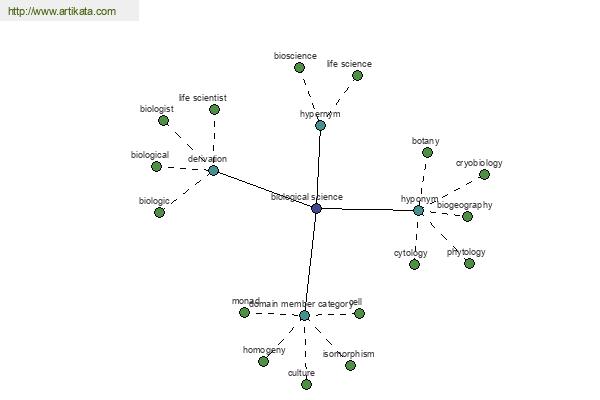 Explore biological science in ArtiKata.com >