plant order
English Thesaurus
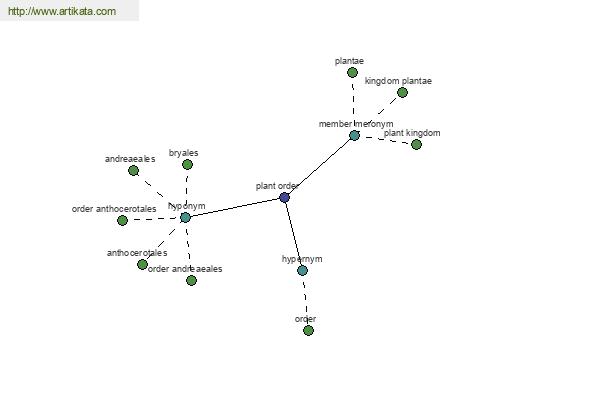
1. the order of plants (noun.plant)
| hypernym | : | order, |
| definition | : | (biology) taxonomic group containing one or more families (noun.group) |
| hyponym | : | anthocerotales, order anthocerotales, |
| definition | : | hornworts; liverworts having a thalloid gametophyte; in some classification systems included in the class Hepaticopsida (noun.plant) |
| hyponym | : | bryales, order bryales, |
| definition | : | category used in some classification systems for mosses having the spore case separated from the capsule wall by a hollow intercellular space (noun.plant) |
| hyponym | : | dicranales, order dicranales, |
| definition | : | widely distributed order of mosses with erect gametophores and sporophytes at the tips of stems (noun.plant) |
| hyponym | : | eubryales, order eubryales, |
| definition | : | mosses with perennial erect gametophores and stems with rows of leaves and drooping capsules (noun.plant) |
| hyponym | : | order sphagnales, sphagnales, |
| definition | : | coextensive with the genus Sphagnum; in some classifications isolated in a separate subclass (noun.plant) |
| hyponym | : | gnetales, order gnetales, |
| definition | : | chiefly tropical or xerophytic woody plants; practically unknown as fossils but considered close to the ancestral line of angiosperms (noun.plant) |
| hyponym | : | cycadales, order cycadales, |
| definition | : | primitive tropical gymnosperms abundant in the Mesozoic, now reduced to a few scattered tropical forms (noun.plant) |
| hyponym | : | cordaitales, order cordaitales, |
| definition | : | extinct plants having tall arborescent trunks comparable to or more advanced than cycads; known from the Pennsylvanian period; probably extinct since the Mesozoic era (noun.plant) |
| hyponym | : | coniferales, order coniferales, |
| definition | : | profusely branching and chiefly evergreen trees and some shrubs having narrow or needlelike leaves (noun.plant) |
| hyponym | : | ginkgoales, order ginkgoales, |
| definition | : | coextensive with the family Ginkgoaceae: plants that first appeared in the Permian and now represented by a single surviving species; often included in Coniferales (noun.plant) |
| hyponym | : | order ranales, order ranunculales, ranales, ranunculales, |
| definition | : | herbs, shrubs and trees: includes families Ranunculaceae; Annonaceae; Berberidaceae; Magnoliaceae; Menispermaceae; Myristicaceae; Nymphaeaceae; Lardizabalaceae; Lauraceae; Calycanthaceae; Ceratophyllaceae; Cercidiphyllaceae (noun.plant) |
| hyponym | : | campanulales, order campanulales, |
| definition | : | an order of plants of the subclass Asteridae including: Campanulaceae; Lobeliaceae; Cucurbitaceae; Goodeniaceae; Compositae (noun.plant) |
| hyponym | : | orchidales, order orchidales, |
| definition | : | order of plants with irregular flowers having minute seeds: Orchidaceae; Burmanniaceae (noun.plant) |
| hyponym | : | order primulales, primulales, |
| definition | : | Primulaceae; Theophrastaceae; Myrsinaceae; and (in some classifications) Plumbaginaceae (noun.plant) |
| hyponym | : | malvales, order malvales, |
| definition | : | Malvaceae; Bombacaceae; Elaeocarpaceae; Sterculiaceae; Tiliaceae (noun.plant) |
| hyponym | : | order umbellales, umbellales, |
| definition | : | plants having umbels or corymbs of uniovulate flowers; includes the Umbelliferae (chiefly herbs) and Cornaceae (chiefly trees or shrubs) (noun.plant) |
| hyponym | : | casuarinales, order casuarinales, |
| definition | : | order of chiefly Australian trees and shrubs comprising the casuarinas; 1 family: Casuarinaceae (noun.plant) |
| hyponym | : | ericales, order ericales, |
| definition | : | Ericaceae; Clethraceae; Diapensiaceae; Epacridaceae; Lennoaceae; Pyrolaceae; Monotropaceae (noun.plant) |
| hyponym | : | fagales, order fagales, |
| definition | : | an order of dicotyledonous trees of the subclass Hamamelidae (noun.plant) |
| hyponym | : | gentianales, order gentianales, |
| definition | : | an order of dicotyledonous plants having gamopetalous flowers; Gentianaceae; Apocynaceae; Asclepiadaceae; Loganiaceae; Oleaceae; Salvadoraceae (noun.plant) |
| hyponym | : | oleales, order oleales, |
| definition | : | coextensive with the family Oleaceae; in some classifications included in the order Gentianales (noun.plant) |
| hyponym | : | order urticales, urticales, |
| definition | : | an order of dicotyledonous plants including Moraceae and Urticaceae and Ulmaceae (noun.plant) |
| hyponym | : | liliales, order liliales, |
| definition | : | an order of monocotyledonous plants including Amaryllidaceae and Liliaceae and Iridaceae (noun.plant) |
| hyponym | : | order rosales, rosales, |
| definition | : | in some classifications this category does not include Leguminosae (noun.plant) |
| hyponym | : | order rubiales, rubiales, |
| definition | : | an order of dicotyledonous plants of the subclass Asteridae; have opposite leaves and an inferior compound ovary (noun.plant) |
| hyponym | : | geraniales, order geraniales, |
| definition | : | an order of plants of subclass Rosidae including geraniums and many other plants; see Euphorbiaceae; Geraniaceae; Rutaceae; Malpighiaceae; Simaroubaceae; Meliaceae; Zygophyllaceae; Tropaeolaceae (noun.plant) |
| hyponym | : | order santalales, santalales, |
| definition | : | order of plants distinguished by having a one-celled inferior ovary; many are parasitic or partly parasitic usually on roots (noun.plant) |
| hyponym | : | ebenales, order ebenales, |
| definition | : | trees or shrubs of the families Ebenaceae or Sapotaceae or Styracaceae or Symplocaceae (noun.plant) |
| hyponym | : | order sarraceniales, sarraceniales, |
| definition | : | plants that are variously modified to serve as insect traps: families Sarraceniaceae; Nepenthaceae; Droseraceae (noun.plant) |
| hyponym | : | order polemoniales, polemoniales, |
| definition | : | Polemoniaceae; Solanaceae; Boraginaceae; Labiatae; Lentibulariaceae; Pedaliaceae; in some classifications includes the order Scrophulariales (noun.plant) |
| hyponym | : | order psilotales, psilotales, |
| definition | : | lower vascular plants having dichotomously branched sporophyte divided into aerial shoot and rhizome and lacking true roots (noun.plant) |
| hyponym | : | order psilophytales, psilophytales, |
| definition | : | Paleozoic simple dichotomously branched plants of Europe and eastern Canada including the oldest known vascular land plants (noun.plant) |
| hyponym | : | lycopodiales, order lycopodiales, |
| definition | : | lower vascular plants coextensive with the family Lycopodiaceae; in some classifications includes the Selaginellaceae and Isoetaceae (noun.plant) |
| hyponym | : | isoetales, order isoetales, |
| definition | : | aquatic or marsh-growing fern allies; known to have existed since the Cenozoic; sometimes included in Lycopodiales (noun.plant) |
Visual ArtiKata
 Explore plant order in ArtiKata.com >