organic process
English Thesaurus
1. a process occurring in living organisms (noun.process)
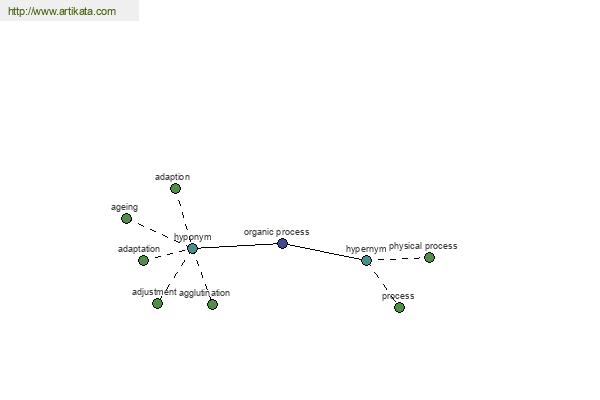
| hypernym | : | physical process, process, |
| definition | : | a sustained phenomenon or one marked by gradual changes through a series of states (noun.tops) |
| hyponym | : | agglutination, |
| definition | : | a clumping of bacteria or red cells when held together by antibodies (agglutinins) (noun.process) |
| hyponym | : | ageing, aging, senescence, |
| definition | : | the organic process of growing older and showing the effects of increasing age (noun.process) |
| hyponym | : | anovulation, |
| definition | : | the absence of ovulation due to immaturity or post-maturity or pregnancy or oral contraceptive pills or dysfunction of the ovary (noun.process) |
| hyponym | : | antisepsis, asepsis, |
| definition | : | the process of inhibiting the growth and multiplication of microorganisms (noun.process) |
| hyponym | : | absorption, assimilation, |
| definition | : | the process of absorbing nutrients into the body after digestion (noun.process) |
| hyponym | : | autoregulation, |
| definition | : | (physiology) processes that maintain a generally constant physiological state in a cell or organism (noun.process) |
| hyponym | : | bacteriostasis, |
| definition | : | inhibition of the growth of bacteria (noun.process) |
| hyponym | : | bloom, blooming, |
| definition | : | the organic process of bearing flowers (noun.process) |
| hyponym | : | carbon cycle, |
| definition | : | the organic circulation of carbon from the atmosphere into organisms and back again (noun.process) |
| hyponym | : | cell division, cellular division, |
| definition | : | the process in reproduction and growth by which a cell divides to form daughter cells (noun.process) |
| hyponym | : | crossing over, crossover, |
| definition | : | the interchange of sections between pairing homologous chromosomes during the prophase of meiosis (noun.process) |
| hyponym | : | defoliation, |
| definition | : | the loss of foliage (noun.process) |
| hyponym | : | deossification, |
| definition | : | the loss of the mineral content of bone tissue (noun.process) |
| hyponym | : | digestion, |
| definition | : | the organic process by which food is converted into substances that can be absorbed into the body (noun.process) |
| hyponym | : | eburnation, |
| definition | : | a change that occurs in degenerative joint disease in which bone is converted into a dense smooth substance resembling ivory (noun.process) |
| hyponym | : | ecchymosis, |
| definition | : | the escape of blood from ruptured blood vessels into the surrounding tissue to form a purple or black-and-blue spot on the skin (noun.process) |
| hyponym | : | effacement, |
| definition | : | shortening of the uterine cervix and thinning of its walls as it is dilated during labor (noun.process) |
| hyponym | : | erythropoiesis, |
| definition | : | the process of producing red blood cells by the stem cells in the bone marrow (noun.process) |
| hyponym | : | eutrophication, |
| definition | : | excessive nutrients in a lake or other body of water, usually caused by runoff of nutrients (animal waste, fertilizers, sewage) from the land, which causes a dense growth of plant life; the decomposition of the plants depletes the supply of oxygen, leading to the death of animal life (noun.process) |
| hyponym | : | expression, |
| definition | : | (genetics) the process of expressing a gene (noun.process) |
| hyponym | : | extravasation, |
| definition | : | the process of exuding or passing out of a vessel into surrounding tissues; said of blood or lymph or urine (noun.process) |
| hyponym | : | gastrulation, |
| definition | : | the process in which a gastrula develops from a blastula by the inward migration of cells (noun.process) |
| hyponym | : | glycogenesis, |
| definition | : | the formation in animals of glycogen from glucose (noun.process) |
| hyponym | : | development, growing, growth, maturation, ontogenesis, ontogeny, |
| definition | : | (biology) the process of an individual organism growing organically; a purely biological unfolding of events involved in an organism changing gradually from a simple to a more complex level (noun.process) |
| hyponym | : | heredity, |
| definition | : | the biological process whereby genetic factors are transmitted from one generation to the next (noun.process) |
| hyponym | : | humification, |
| definition | : | the process of the formation of humus from plant remains (noun.process) |
| hyponym | : | epistasis, hypostasis, |
| definition | : | the suppression of a gene by the effect of an unrelated gene (noun.process) |
| hyponym | : | implantation, nidation, |
| definition | : | (embryology) the organic process whereby a fertilized egg becomes implanted in the lining of the uterus of placental mammals (noun.process) |
| hyponym | : | inhibition, |
| definition | : | (physiology) the process whereby nerves can retard or prevent the functioning of an organ or part (noun.process) |
| hyponym | : | involution, |
| definition | : | reduction in size of an organ or part (as in the return of the uterus to normal size after childbirth) (noun.process) |
| hyponym | : | cytokinesis, |
| definition | : | organic process consisting of the division of the cytoplasm of a cell following karyokinesis bringing about the separation into two daughter cells (noun.process) |
| hyponym | : | karyokinesis, |
| definition | : | organic process consisting of the division of the nucleus of a cell during mitosis or meiosis (noun.process) |
| hyponym | : | keratinisation, keratinization, |
| definition | : | organic process by which keratin is deposited in cells and the cells become horny (as in nails and hair) (noun.process) |
| hyponym | : | lymphopoiesis, |
| definition | : | the formation of lymphocytes in the bone marrow and lymph nodes and thymus and spleen (noun.process) |
| hyponym | : | lysogenisation, lysogenization, |
| definition | : | the process by which a bacterium acquires a phage that becomes integrated into its genome (noun.process) |
| hyponym | : | metabolic process, metabolism, |
| definition | : | the organic processes (in a cell or organism) that are necessary for life (noun.process) |
| hyponym | : | metabolism, metamorphosis, |
| definition | : | the marked and rapid transformation of a larva into an adult that occurs in some animals (noun.process) |
| hyponym | : | nitrogen cycle, |
| definition | : | the circulation of nitrogen; nitrates from the soil are absorbed by plants which are eaten by animals that die and decay returning the nitrogen back to the soil (noun.process) |
| hyponym | : | nitrogen fixation, |
| definition | : | the assimilation of atmospheric nitrogen by soil bacteria and its release for plant use on the death of the bacteria (noun.process) |
| hyponym | : | nondevelopment, |
| definition | : | failure of normal development to occur (noun.process) |
| hyponym | : | nutrition, |
| definition | : | (physiology) the organic process of nourishing or being nourished; the processes by which an organism assimilates food and uses it for growth and maintenance (noun.process) |
| hyponym | : | organification, |
| definition | : | the process of organ formation (noun.process) |
| hyponym | : | ossification, |
| definition | : | the developmental process of bone formation (noun.process) |
| hyponym | : | ovulation, |
| definition | : | the expulsion of an ovum from the ovary (usually midway in the menstrual cycle) (noun.process) |
| hyponym | : | oxidative phosphorylation, |
| definition | : | an enzymatic process in cell metabolism that synthesizes ATP from ADP (noun.process) |
| hyponym | : | perennation, |
| definition | : | the process of living through a number of years (as a perennial plant) (noun.process) |
| hyponym | : | preservation, |
| definition | : | a process that saves organic substances from decay (noun.process) |
| hyponym | : | quellung, quellung reaction, |
| definition | : | the swelling of the capsule surrounding a microorganism after reaction with an antibody; the basis of certain tests for identifying microorganisms (noun.process) |
| hyponym | : | quickening, |
| definition | : | the process of showing signs of life (noun.process) |
| hyponym | : | regeneration, |
| definition | : | (biology) growth anew of lost tissue or destroyed parts or organs (noun.process) |
| hyponym | : | regulation, |
| definition | : | (embryology) the ability of an early embryo to continue normal development after its structure has been somehow damaged or altered (noun.process) |
| hyponym | : | replication, |
| definition | : | (genetics) the process whereby DNA makes a copy of itself before cell division (noun.process) |
| hyponym | : | reproduction, |
| definition | : | the process of generating offspring (noun.process) |
| hyponym | : | reabsorption, resorption, |
| definition | : | the organic process in which the substance of some differentiated structure that has been produced by the body undergoes lysis and assimilation (noun.process) |
| hyponym | : | ageing, aging, ripening, |
| definition | : | acquiring desirable qualities by being left undisturbed for some time (noun.process) |
| hyponym | : | secernment, secretion, |
| definition | : | the organic process of synthesizing and releasing some substance (noun.process) |
| hyponym | : | segregation, |
| definition | : | (genetics) the separation of paired alleles during meiosis so that members of each pair of alleles appear in different gametes (noun.process) |
| hyponym | : | shedding, sloughing, |
| definition | : | the process whereby something is shed (noun.process) |
| hyponym | : | summation, |
| definition | : | (physiology) the process whereby multiple stimuli can produce a response (in a muscle or nerve or other part) that one stimulus alone does not produce (noun.process) |
| hyponym | : | symphysis, |
| definition | : | a growing together of parts or structures (noun.process) |
| hyponym | : | synapsis, |
| definition | : | the side by side pairing of homologous maternal and paternal chromosomes at the start of meiosis (noun.process) |
| hyponym | : | synezesis, synizesis, |
| definition | : | the contraction of chromatin towards one side of the nucleus during the prophase of meiosis (noun.process) |
| hyponym | : | transcription, |
| definition | : | (genetics) the organic process whereby the DNA sequence in a gene is copied into mRNA; the process whereby a base sequence of messenger RNA is synthesized on a template of complementary DNA (noun.process) |
| hyponym | : | transduction, |
| definition | : | (genetics) the process of transfering genetic material from one cell to another by a plasmid or bacteriophage (noun.process) |
| hyponym | : | translation, |
| definition | : | (genetics) the process whereby genetic information coded in messenger RNA directs the formation of a specific protein at a ribosome in the cytoplasm (noun.process) |
| hyponym | : | folding, protein folding, |
| definition | : | the process whereby a protein molecule assumes its intricate three-dimensional shape (noun.process) |
| hyponym | : | translocation, |
| definition | : | (genetics) an exchange of chromosome parts (noun.process) |
| hyponym | : | translocation, |
| definition | : | the transport of dissolved material within a plant (noun.process) |
| hyponym | : | transpiration, |
| definition | : | the emission of water vapor from the leaves of plants (noun.process) |
| hyponym | : | tumefaction, |
| definition | : | the process of tumefying; the organic process whereby tissue becomes swollen by the accumulation of fluid within it (noun.process) |
| hyponym | : | ulceration, |
| definition | : | the process of ulcer formation; the process of becoming ulcerated (noun.process) |
Visual ArtiKata
 Explore organic process in ArtiKata.com >