greek deity
English Thesaurus
1. a deity worshipped by the ancient Greeks (noun.person)
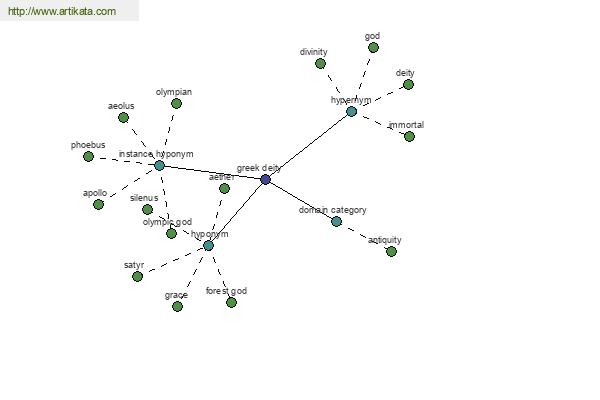
| hypernym | : | deity, divinity, god, immortal, |
| definition | : | any supernatural being worshipped as controlling some part of the world or some aspect of life or who is the personification of a force (noun.person) |
| hyponym | : | grace, |
| definition | : | (Greek mythology) one of three sisters who were the givers of beauty and charm; a favorite subject for sculptors (noun.person) |
| hyponym | : | forest god, satyr, |
| definition | : | one of a class of woodland deities; attendant on Bacchus; identified with Roman fauns (noun.person) |
| hyponym | : | silenus, |
| definition | : | any of the minor woodland deities who were companions of Dionysus (similar to the satyrs) (noun.person) |
| hyponym | : | aether, |
| definition | : | personification of the sky or upper air breathed by the Olympians; son of Erebus and night or of Chaos and darkness (noun.person) |
| hyponym | : | moirae, moirai, |
| definition | : | any of the three Greek goddesses of fate or destiny; identified with the Roman Parcae and similar to the Norse Norns (noun.person) |
| hyponym | : | muse, |
| definition | : | in ancient Greek mythology any of 9 daughters of Zeus and Mnemosyne; protector of an art or science (noun.person) |
| hyponym | : | pontos, pontus, |
| definition | : | (Greek mythology) ancient personification of the sea; father of Nereus (noun.person) |
| hyponym | : | rhadamanthus, |
| definition | : | (Greek mythology) a judge of the dead in the underworld (noun.person) |
| instance hyponym | : | olympian, olympic god, |
| definition | : | a classical Greek god after the overthrow of the Titans (noun.person) |
| instance hyponym | : | aeolus, |
| definition | : | god of the winds in ancient mythology (noun.person) |
| instance hyponym | : | apollo, phoebus, phoebus apollo, |
| definition | : | (Greek mythology) Greek god of light; god of prophecy and poetry and music and healing; son of Zeus and Leto; twin brother of Artemis (noun.person) |
| instance hyponym | : | aphrodite, cytherea, |
| definition | : | goddess of love and beauty and daughter of Zeus in ancient mythology; identified with Roman Venus (noun.person) |
| instance hyponym | : | ares, |
| definition | : | (Greek mythology) Greek god of war; son of Zeus and Hera; identified with Roman Mars (noun.person) |
| instance hyponym | : | eris, |
| definition | : | (Greek mythology) goddess of discord; sister of Ares (noun.person) |
| instance hyponym | : | thanatos, |
| definition | : | (Greek mythology) the Greek personification of death; son of Nyx (noun.person) |
| instance hyponym | : | nyx, |
| definition | : | (Greek mythology) Greek goddess of the night; daughter of Chaos; counterpart of Roman Nox (noun.person) |
| instance hyponym | : | artemis, cynthia, |
| definition | : | (Greek mythology) the virgin goddess of the hunt and the Moon; daughter of Leto and twin sister of Apollo; identified with Roman Diana (noun.person) |
| instance hyponym | : | boreas, |
| definition | : | (Greek mythology) the god who personified the north wind (noun.person) |
| instance hyponym | : | ate, |
| definition | : | goddess of criminal rashness and its punishment (noun.person) |
| instance hyponym | : | chaos, |
| definition | : | (Greek mythology) the most ancient of gods; the personification of the infinity of space preceding creation of the universe (noun.person) |
| instance hyponym | : | demeter, |
| definition | : | (Greek mythology) goddess of fertility and protector of marriage in ancient mythology; counterpart of Roman Ceres (noun.person) |
| instance hyponym | : | dionysus, |
| definition | : | (Greek mythology) god of wine and fertility and drama; the Greek name of Bacchus (noun.person) |
| instance hyponym | : | doris, |
| definition | : | (Greek mythology) wife of Nereus and mother of the Nereids (noun.person) |
| instance hyponym | : | erebus, |
| definition | : | (Greek mythology) Greek god of darkness who dwelt in the underworld; son of Chaos; brother of Nox; father of Aether and Day (noun.person) |
| instance hyponym | : | eros, |
| definition | : | (Greek mythology) god of love; son of Aphrodite; identified with Roman Cupid (noun.person) |
| instance hyponym | : | gaea, gaia, ge, |
| definition | : | (Greek mythology) goddess of the earth and mother of Cronus and the Titans in ancient mythology (noun.person) |
| instance hyponym | : | hebe, |
| definition | : | (Greek mythology) the goddess of youth and spring; wife of Hercules; daughter of Zeus and Hera; cupbearer to the Olympian gods (noun.person) |
| instance hyponym | : | helios, |
| definition | : | (Greek mythology) ancient god of the sun; drove his chariot across the sky each day; identified with Roman Sol (noun.person) |
| instance hyponym | : | hecate, |
| definition | : | (Greek mythology) Greek goddess of fertility who later became associated with Persephone as goddess of the underworld and protector of witches (noun.person) |
| instance hyponym | : | hephaestus, hephaistos, |
| definition | : | (Greek mythology) the lame god of fire and metalworking in ancient mythology; identified with Roman Vulcan (noun.person) |
| instance hyponym | : | hermes, |
| definition | : | (Greek mythology) messenger and herald of the gods; god of commerce and cunning and invention and theft; identified with Roman Mercury (noun.person) |
| instance hyponym | : | hermaphroditus, |
| definition | : | (Greek mythology) son of Hermes and Aphrodite who merged with the nymph Salmacis to form one body (noun.person) |
| instance hyponym | : | hygeia, |
| definition | : | (Greek mythology) the goddess of health; daughter of Aesculapius and sister of Panacea (noun.person) |
| instance hyponym | : | panacea, |
| definition | : | (Greek mythology) the goddess of healing; daughter of Aesculapius and sister of Hygeia (noun.person) |
| instance hyponym | : | hera, here, |
| definition | : | queen of the Olympian gods in ancient Greek mythology; sister and wife of Zeus remembered for her jealously of the many mortal women Zeus fell in love with; identified with Roman Juno (noun.person) |
| instance hyponym | : | hestia, |
| definition | : | (Greek mythology) the goddess of the hearth and its fire in ancient mythology; identified with Roman Vesta (noun.person) |
| instance hyponym | : | hymen, |
| definition | : | (Greek mythology) the god of marriage (noun.person) |
| instance hyponym | : | minos, |
| definition | : | son of Zeus and Europa; king of ancient Crete; ordered Daedalus to build the labyrinth; after death Minos became a judge in the underworld (noun.person) |
| instance hyponym | : | ariadne, |
| definition | : | beautiful daughter of Minos and Pasiphae; she fell in love with Theseus and gave him the thread with which he found his way out of the Minotaur's labyrinth (noun.person) |
| instance hyponym | : | clotho, klotho, |
| definition | : | the Greek goddess of fate who spins the thread of life (noun.person) |
| instance hyponym | : | lachesis, |
| definition | : | the Greek goddess of fate who determines the length of the thread of life (noun.person) |
| instance hyponym | : | atropos, |
| definition | : | the Greek goddess of fate who cuts the thread of life (noun.person) |
| instance hyponym | : | momos, momus, |
| definition | : | god of blame and mockery (noun.person) |
| instance hyponym | : | nemesis, |
| definition | : | (Greek mythology) the goddess of divine retribution and vengeance (noun.person) |
| instance hyponym | : | nereus, |
| definition | : | (Greek mythology) a sea god son of Pontus and Gaea; lived in the depths of the sea with his wife Doris and their daughters the Nereids (noun.person) |
| instance hyponym | : | nike, |
| definition | : | (Greek mythology) winged goddess of victory; identified with Roman Victoria (noun.person) |
| instance hyponym | : | ouranos, uranus, |
| definition | : | (Greek mythology) god of the heavens; son and husband of Gaea and father of the Titans in ancient mythology (noun.person) |
| instance hyponym | : | goat god, pan, |
| definition | : | (Greek mythology) god of fields and woods and shepherds and flocks; represented as a man with goat's legs and horns and ears; identified with Roman Sylvanus or Faunus (noun.person) |
| instance hyponym | : | pasiphae, |
| definition | : | (Greek mythology) daughter of Helios and mother of Ariadne (noun.person) |
| instance hyponym | : | poseidon, |
| definition | : | (Greek mythology) the god of the sea and earthquakes in ancient mythology; brother of Zeus and Hades and Hera; identified with Roman Neptune (noun.person) |
| instance hyponym | : | proteus, |
| definition | : | (Greek mythology) a prophetic god who served Poseidon; was capable of changing his shape at will (noun.person) |
| instance hyponym | : | cora, despoina, kore, persephone, |
| definition | : | (Greek mythology) daughter of Zeus and Demeter; made queen of the underworld by Pluto in ancient mythology; identified with Roman Proserpina (noun.person) |
| instance hyponym | : | phaethon, |
| definition | : | (Greek mythology) son of Helios; killed when trying to drive his father's chariot and came too close to earth (noun.person) |
| instance hyponym | : | aides, aidoneus, hades, pluto, |
| definition | : | (Greek mythology) the god of the underworld in ancient mythology; brother of Zeus and husband of Persephone (noun.person) |
| instance hyponym | : | pythia, pythoness, |
| definition | : | (Greek mythology) the priestess of Apollo at Delphi who transmitted the oracles (noun.person) |
| instance hyponym | : | selene, |
| definition | : | (Greek mythology) goddess of the Moon in ancient mythology; identified with Roman Luna (noun.person) |
| instance hyponym | : | eos, |
| definition | : | (Greek mythology) the winged goddess of the dawn in ancient mythology; daughter of Hyperion; identified with Roman Aurora (noun.person) |
| instance hyponym | : | titan, |
| definition | : | (Greek mythology) any of the primordial giant gods who ruled the Earth until overthrown by Zeus; the Titans were offspring of Uranus (Heaven) and Gaea (Earth) (noun.person) |
| instance hyponym | : | titaness, |
| definition | : | (Greek mythology) any of the primordial giant goddesses who were offspring of Uranus (heaven) and Gaea (earth) in ancient mythology (noun.person) |
| instance hyponym | : | triton, |
| definition | : | (Greek mythology) a sea god; son of Poseidon (noun.person) |
| instance hyponym | : | tyche, |
| definition | : | (Greek mythology) the goddess of fortune; identified with Roman Fortuna (noun.person) |
| instance hyponym | : | zephyr, |
| definition | : | (Greek mythology) the Greek god of the west wind (noun.person) |
| instance hyponym | : | zeus, |
| definition | : | (Greek mythology) the supreme god of ancient Greek mythology; son of Rhea and Cronus whom he dethroned; husband and brother of Hera; brother of Poseidon and Hades; father of many gods; counterpart of Roman Jupiter (noun.person) |
| domain category | : | antiquity, |
| definition | : | the historic period preceding the Middle Ages in Europe (noun.time) |
Visual ArtiKata
 Explore greek deity in ArtiKata.com >