diverge
English Thesaurus
1. move or draw apart (verb.motion)
| hypernym | : | move, |
| definition | : | move so as to change position, perform a nontranslational motion (verb.motion) |
2. be at variance with; be out of line with (verb.stative)
| hypernym | : | differ, |
| definition | : | be different (verb.stative) |
| hyponym | : | aberrate, |
| definition | : | diverge or deviate from the straight path; produce aberration (verb.stative) |
| hyponym | : | aberrate, |
| definition | : | diverge from the expected (verb.stative) |
3. extend in a different direction (verb.stative)
| hyponym | : | divaricate, |
| definition | : | branch off (verb.stative) |
| hyponym | : | bifurcate, |
| definition | : | split or divide into two (verb.stative) |
4. have no limits as a mathematical series (verb.stative)
| hypernym | : | be, |
| definition | : | have the quality of being; (copula, used with an adjective or a predicate noun) (verb.stative) |
| domain category | : | math, mathematics, maths, |
| definition | : | a science (or group of related sciences) dealing with the logic of quantity and shape and arrangement (noun.cognition) |
5. move or draw apart (verb.motion)
| antonym | : | converge, |
| definition | : | move or draw together at a certain location (verb.motion) |
| derivation | : | divergence, divergency, |
| definition | : | the act of moving away in different direction from a common point (noun.act) |
| derivation | : | divergent, diverging, |
| definition | : | tending to move apart in different directions (adj.all) |
6. be at variance with; be out of line with (verb.stative)
| antonym | : | conform, |
| definition | : | be similar, be in line with (verb.stative) |
| derivation | : | variance, variation, |
| definition | : | an activity that varies from a norm or standard (noun.act) |
| derivation | : | deviation, |
| definition | : | the error of a compass due to local magnetic disturbances (noun.attribute) |
| derivation | : | deviation, |
| definition | : | the difference between an observed value and the expected value of a variable or function (noun.cognition) |
| derivation | : | mutant, mutation, sport, variation, |
| definition | : | (biology) an organism that has characteristics resulting from chromosomal alteration (noun.person) |
| derivation | : | degenerate, deviant, deviate, pervert, |
| definition | : | a person whose behavior deviates from what is acceptable especially in sexual behavior (noun.person) |
| derivation | : | variation, |
| definition | : | (astronomy) any perturbation of the mean motion or orbit of a planet or satellite (especially a perturbation of the earth's moon) (noun.phenomenon) |
| derivation | : | divergent, |
| definition | : | diverging from another or from a standard (adj.all) |
| derivation | : | variant, |
| definition | : | differing from a norm or standard (adj.all) |
7. extend in a different direction (verb.stative)
| antonym | : | converge, meet, |
| definition | : | be adjacent or come together (verb.stative) |
| derivation | : | divergence, divergency, |
| definition | : | the act of moving away in different direction from a common point (noun.act) |
| derivation | : | divergent, diverging, |
| definition | : | tending to move apart in different directions (adj.all) |
8. have no limits as a mathematical series (verb.stative)
| antonym | : | converge, meet, |
| definition | : | be adjacent or come together (verb.stative) |
| antonym | : | converge, |
| definition | : | approach a limit as the number of terms increases without limit (verb.stative) |
9. move or draw apart (verb.motion)
| antonym | : | converge, |
| definition | : | move or draw together at a certain location (verb.motion) |
| derivation | : | divergence, divergency, |
| definition | : | the act of moving away in different direction from a common point (noun.act) |
| derivation | : | divergent, diverging, |
| definition | : | tending to move apart in different directions (adj.all) |
10. be at variance with; be out of line with (verb.stative)
| antonym | : | conform, |
| definition | : | be similar, be in line with (verb.stative) |
| derivation | : | variance, variation, |
| definition | : | an activity that varies from a norm or standard (noun.act) |
| derivation | : | deviation, |
| definition | : | the error of a compass due to local magnetic disturbances (noun.attribute) |
| derivation | : | deviation, |
| definition | : | the difference between an observed value and the expected value of a variable or function (noun.cognition) |
| derivation | : | mutant, mutation, sport, variation, |
| definition | : | (biology) an organism that has characteristics resulting from chromosomal alteration (noun.person) |
| derivation | : | degenerate, deviant, deviate, pervert, |
| definition | : | a person whose behavior deviates from what is acceptable especially in sexual behavior (noun.person) |
| derivation | : | variation, |
| definition | : | (astronomy) any perturbation of the mean motion or orbit of a planet or satellite (especially a perturbation of the earth's moon) (noun.phenomenon) |
| derivation | : | divergent, |
| definition | : | diverging from another or from a standard (adj.all) |
| derivation | : | variant, |
| definition | : | differing from a norm or standard (adj.all) |
11. extend in a different direction (verb.stative)
| antonym | : | converge, meet, |
| definition | : | be adjacent or come together (verb.stative) |
| derivation | : | divergence, divergency, |
| definition | : | the act of moving away in different direction from a common point (noun.act) |
| derivation | : | divergent, diverging, |
| definition | : | tending to move apart in different directions (adj.all) |
12. have no limits as a mathematical series (verb.stative)
| antonym | : | converge, meet, |
| definition | : | be adjacent or come together (verb.stative) |
| antonym | : | converge, |
| definition | : | approach a limit as the number of terms increases without limit (verb.stative) |
Visual ArtiKata
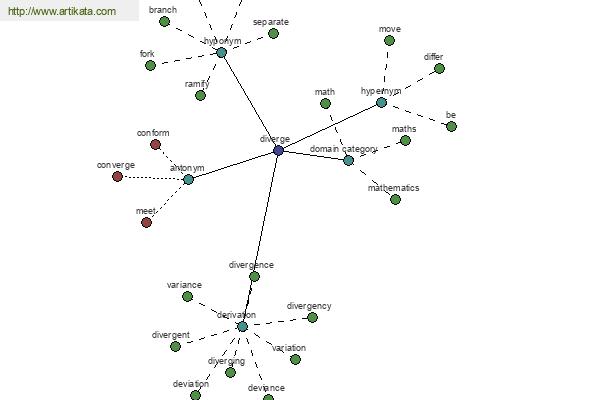 Explore diverge in ArtiKata.com >