attribute
English Thesaurus
1. an abstraction belonging to or characteristic of an entity (noun.tops)
| hypernym | : | abstract entity, abstraction, |
| definition | : | a general concept formed by extracting common features from specific examples (noun.tops) |
| hyponym | : | state, |
| definition | : | the way something is with respect to its main attributes (noun.tops) |
| hyponym | : | form, shape, |
| definition | : | the spatial arrangement of something as distinct from its substance (noun.tops) |
| hyponym | : | time, |
| definition | : | the continuum of experience in which events pass from the future through the present to the past (noun.tops) |
| hyponym | : | infinite, space, |
| definition | : | the unlimited expanse in which everything is located (noun.tops) |
| hyponym | : | human nature, |
| definition | : | the shared psychological attributes of humankind that are assumed to be shared by all human beings (noun.attribute) |
| hyponym | : | trait, |
| definition | : | a distinguishing feature of your personal nature (noun.attribute) |
| hyponym | : | character, |
| definition | : | (genetics) an attribute (structural or functional) that is determined by a gene or group of genes (noun.attribute) |
| hyponym | : | thing, |
| definition | : | any attribute or quality considered as having its own existence (noun.attribute) |
| hyponym | : | common denominator, |
| definition | : | an attribute that is common to all members of a category (noun.attribute) |
| hyponym | : | personality, |
| definition | : | the complex of all the attributes--behavioral, temperamental, emotional and mental--that characterize a unique individual (noun.attribute) |
| hyponym | : | uncheerfulness, |
| definition | : | not conducive to cheer or good spirits (noun.attribute) |
| hyponym | : | ballast, |
| definition | : | an attribute that tends to give stability in character and morals; something that steadies the mind or feelings (noun.attribute) |
| hyponym | : | ethos, |
| definition | : | (anthropology) the distinctive spirit of a culture or an era (noun.attribute) |
| hyponym | : | eidos, |
| definition | : | (anthropology) the distinctive expression of the cognitive or intellectual character of a culture or a social group (noun.attribute) |
| hyponym | : | quality, |
| definition | : | an essential and distinguishing attribute of something or someone (noun.attribute) |
| hyponym | : | property, |
| definition | : | a basic or essential attribute shared by all members of a class (noun.attribute) |
| hyponym | : | heritage, inheritance, |
| definition | : | any attribute or immaterial possession that is inherited from ancestors (noun.attribute) |
| hyponym | : | depth, |
| definition | : | the attribute or quality of being deep, strong, or intense (noun.attribute) |
2. a construct whereby objects or individuals can be distinguished (noun.cognition)
| hypernym | : | concept, conception, construct, |
| definition | : | an abstract or general idea inferred or derived from specific instances (noun.cognition) |
| hyponym | : | character, lineament, quality, |
| definition | : | a characteristic property that defines the apparent individual nature of something (noun.cognition) |
| hyponym | : | characteristic, feature, |
| definition | : | a prominent attribute or aspect of something (noun.cognition) |
| hyponym | : | feature, feature of speech, |
| definition | : | (linguistics) a distinctive characteristic of a linguistic unit that serves to distinguish it from other units of the same kind (noun.cognition) |
3. attribute or credit to (verb.cognition)
| hyponym | : | impute, |
| definition | : | attribute (responsibility or fault) to a cause or source (verb.cognition) |
| hyponym | : | credit, |
| definition | : | give someone credit for something (verb.cognition) |
| hyponym | : | reattribute, |
| definition | : | attribute to another source (verb.cognition) |
| hyponym | : | personate, personify, |
| definition | : | attribute human qualities to something (verb.cognition) |
| hyponym | : | accredit, credit, |
| definition | : | ascribe an achievement to (verb.cognition) |
| hyponym | : | blame, charge, |
| definition | : | attribute responsibility to (verb.cognition) |
| verb group | : | impute, |
| definition | : | attribute (responsibility or fault) to a cause or source (verb.cognition) |
4. decide as to where something belongs in a scheme (verb.cognition)
| hyponym | : | classify, relegate, |
| definition | : | assign to a class or kind (verb.cognition) |
5. attribute or credit to (verb.cognition)
| derivation | : | imputation, |
| definition | : | the attribution to a source or cause (noun.cognition) |
| derivation | : | attributable, |
| definition | : | capable of being attributed (adj.all) |
6. decide as to where something belongs in a scheme (verb.cognition)
| derivation | : | assigning, assignment, |
| definition | : | the act of distributing something to designated places or persons (noun.act) |
7. attribute or credit to (verb.cognition)
| derivation | : | imputation, |
| definition | : | the attribution to a source or cause (noun.cognition) |
| derivation | : | attributable, |
| definition | : | capable of being attributed (adj.all) |
8. decide as to where something belongs in a scheme (verb.cognition)
| derivation | : | assigning, assignment, |
| definition | : | the act of distributing something to designated places or persons (noun.act) |
Visual ArtiKata
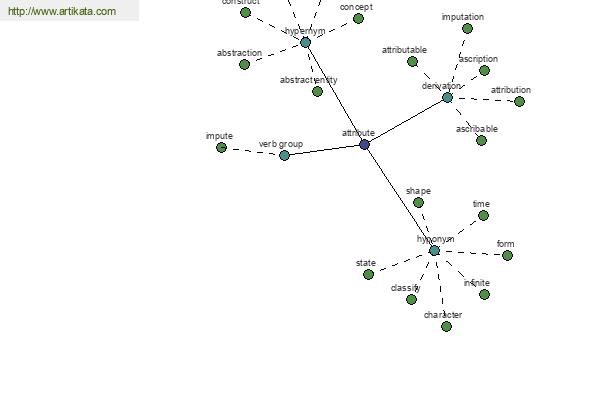 Explore attribute in ArtiKata.com >