physiology
English Thesaurus
1. processes and functions of an organism (noun.attribute)
| hypernym | : | bodily property, |
| definition | : | an attribute of the body (noun.attribute) |
| domain member category | : | facilitate, |
| definition | : | increase the likelihood of (a response) (verb.creation) |
2. the branch of the biological sciences dealing with the functioning of organisms (noun.cognition)
| hyponym | : | neurophysiology, |
| definition | : | the branch of neuroscience that studies the physiology of the nervous system (noun.cognition) |
| hyponym | : | hemodynamics, |
| definition | : | the branch of physiology that studies the circulation of the blood and the forces involved (noun.cognition) |
| hyponym | : | kinesiology, |
| definition | : | the branch of physiology that studies the mechanics and anatomy in relation to human movement (noun.cognition) |
| hyponym | : | myology, |
| definition | : | the branch of physiology that studies muscles (noun.cognition) |
| domain member category | : | accommodation, |
| definition | : | (physiology) the automatic adjustment in focal length of the natural lens of the eye (noun.act) |
| domain member category | : | adaptation, |
| definition | : | (physiology) the responsive adjustment of a sense organ (as the eye) to varying conditions (as of light) (noun.act) |
| domain member category | : | abduction, |
| definition | : | (physiology) moving of a body part away from the central axis of the body (noun.act) |
| domain member category | : | adduction, |
| definition | : | (physiology) moving of a body part toward the central axis of the body (noun.act) |
| domain member category | : | control, |
| definition | : | (physiology) regulation or maintenance of a function or action or reflex etc (noun.act) |
| domain member category | : | antagonistic muscle, |
| definition | : | (physiology) a muscle that opposes the action of another (noun.body) |
| domain member category | : | humor, humour, |
| definition | : | (Middle Ages) one of the four fluids in the body whose balance was believed to determine your emotional and physical state (noun.body) |
| domain member category | : | irradiation, |
| definition | : | (physiology) the spread of sensory neural impulses in the cortex (noun.event) |
| domain member category | : | cell death, necrobiosis, |
| definition | : | (physiology) the normal degeneration and death of living cells (as in various epithelial cells) (noun.phenomenon) |
| domain member category | : | autoregulation, |
| definition | : | (physiology) processes that maintain a generally constant physiological state in a cell or organism (noun.process) |
| domain member category | : | inhibition, |
| definition | : | (physiology) the process whereby nerves can retard or prevent the functioning of an organ or part (noun.process) |
| domain member category | : | nutrition, |
| definition | : | (physiology) the organic process of nourishing or being nourished; the processes by which an organism assimilates food and uses it for growth and maintenance (noun.process) |
| domain member category | : | relaxation, |
| definition | : | (physiology) the gradual lengthening of inactive muscle or muscle fibers (noun.process) |
| domain member category | : | stimulation, |
| definition | : | (physiology) the effect of a stimulus (on nerves or organs etc.) (noun.process) |
| domain member category | : | summation, |
| definition | : | (physiology) the process whereby multiple stimuli can produce a response (in a muscle or nerve or other part) that one stimulus alone does not produce (noun.process) |
| domain member category | : | homeostasis, |
| definition | : | (physiology) metabolic equilibrium actively maintained by several complex biological mechanisms that operate via the autonomic nervous system to offset disrupting changes (noun.state) |
| domain member category | : | innervate, |
| definition | : | stimulate to action (verb.change) |
| domain member category | : | irritate, |
| definition | : | excite to some characteristic action or condition, such as motion, contraction, or nervous impulse, by the application of a stimulus (verb.change) |
| domain member category | : | abducent, abducting, |
| definition | : | especially of muscles; drawing away from the midline of the body or from an adjacent part (adj.all) |
| domain member category | : | adducent, adducting, adductive, |
| definition | : | especially of muscles; bringing together or drawing toward the midline of the body or toward an adjacent part (adj.all) |
| domain member category | : | afferent, |
| definition | : | of nerves and nerve impulses; conveying sensory information from the sense organs to the CNS (adj.all) |
| domain member category | : | efferent, motorial, |
| definition | : | of nerves and nerve impulses; conveying information away from the CNS (adj.all) |
| domain member category | : | isometric, |
| definition | : | of or involving muscular contraction in which tension increases while length remains constant (adj.all) |
| domain member category | : | isotonic, |
| definition | : | of or involving muscular contraction in which tension is constant while length changes (adj.all) |
| domain member category | : | cavernous, erectile, |
| definition | : | filled with vascular sinuses and capable of becoming distended and rigid as the result of being filled with blood (adj.all) |
| domain member category | : | erect, tumid, |
| definition | : | of sexual organs; stiff and rigid (adj.all) |
| domain member category | : | antidromic, |
| definition | : | conducting nerve impulses in a direction opposite to normal (adj.all) |
| domain member category | : | excitable, irritable, |
| definition | : | capable of responding to stimuli (adj.all) |
| domain member category | : | isotonic, |
| definition | : | of two or more muscles; having equal tension (adj.all) |
| domain member category | : | unaerated, unoxygenated, |
| definition | : | (used of blood) not supplied with oxygen (adj.all) |
| domain member category | : | voluntary, |
| definition | : | controlled by individual volition (adj.all) |
| domain member category | : | involuntary, |
| definition | : | controlled by the autonomic nervous system; without conscious control (adj.all) |
| domain member category | : | autonomic, |
| definition | : | relating to or controlled by the autonomic nervous system (adj.all) |
| domain member category | : | vegetative, |
| definition | : | relating to involuntary bodily functions (adj.all) |
| domain member category | : | autacoidal, |
| definition | : | of or relating to an autacoid (adj.pert) |
| domain member category | : | pressor, |
| definition | : | increasing (or tending to increase) blood pressure (adj.pert) |
| domain member category | : | tonic, |
| definition | : | of or relating to or producing normal tone or tonus in muscles or tissue (adj.pert) |
| domain member category | : | sympathetic, |
| definition | : | of or relating to the sympathetic nervous system (adj.pert) |
| domain member category | : | parenteral, |
| definition | : | located outside the alimentary tract (adj.pert) |
3. processes and functions of an organism (noun.attribute)
| derivation | : | physiologist, |
| definition | : | a biologist specializing in physiology (noun.person) |
| derivation | : | physiological, |
| definition | : | of or relating to the biological study of physiology (adj.pert) |
4. the branch of the biological sciences dealing with the functioning of organisms (noun.cognition)
| derivation | : | physiologist, |
| definition | : | a biologist specializing in physiology (noun.person) |
5. processes and functions of an organism (noun.attribute)
| derivation | : | physiologist, |
| definition | : | a biologist specializing in physiology (noun.person) |
| derivation | : | physiological, |
| definition | : | of or relating to the biological study of physiology (adj.pert) |
6. the branch of the biological sciences dealing with the functioning of organisms (noun.cognition)
| derivation | : | physiologist, |
| definition | : | a biologist specializing in physiology (noun.person) |
Visual ArtiKata
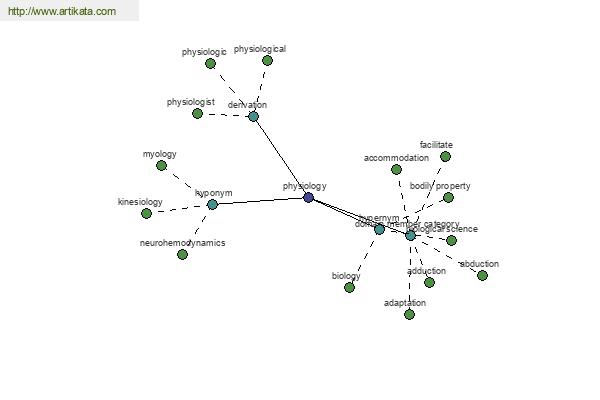 Explore physiology in ArtiKata.com >