element
English Thesaurus
1. an artifact that is one of the individual parts of which a composite entity is made up; especially a part that can be separated from or attached to a system (noun.artifact)
| hypernym | : | part, portion, |
| definition | : | something less than the whole of a human artifact (noun.artifact) |
| hyponym | : | add-on, addition, improver, |
| definition | : | a component that is added to something to improve it (noun.artifact) |
| hyponym | : | audio, |
| definition | : | the sound elements of television (noun.artifact) |
| hyponym | : | crystal, |
| definition | : | a crystalline element used as a component in various electronic devices (noun.artifact) |
| hyponym | : | computer hardware, hardware, |
| definition | : | (computer science) the mechanical, magnetic, electronic, and electrical components making up a computer system (noun.artifact) |
| hyponym | : | heating element, |
| definition | : | the component of a heater or range that transforms fuel or electricity into heat (noun.artifact) |
| hyponym | : | ingredient, |
| definition | : | a component of a mixture or compound (noun.artifact) |
| hyponym | : | input, |
| definition | : | a component of production; something that goes into the production of output (noun.artifact) |
| hyponym | : | landside, |
| definition | : | component consisting of a side piece opposite the moldboard (noun.artifact) |
| hyponym | : | making, |
| definition | : | (usually plural) the components needed for making or doing something (noun.artifact) |
| hyponym | : | module, |
| definition | : | a self-contained component (unit or item) that is used in combination with other components (noun.artifact) |
| hyponym | : | pel, picture element, pixel, |
| definition | : | (computer science) the smallest discrete component of an image or picture on a CRT screen (usually a colored dot) (noun.artifact) |
| hyponym | : | retrofit, |
| definition | : | a component or accessory added to something after it has been manufactured (noun.artifact) |
| hyponym | : | spare, spare part, |
| definition | : | an extra component of a machine or other apparatus (noun.artifact) |
| hyponym | : | spark gap, |
| definition | : | a component of an ignition system; consists of two shaped electrodes and the space between them (noun.artifact) |
2. an abstract part of something (noun.cognition)
| hypernym | : | division, part, section, |
| definition | : | one of the portions into which something is regarded as divided and which together constitute a whole (noun.cognition) |
| hyponym | : | plot element, |
| definition | : | a component or element of the plot of a story (noun.cognition) |
| hyponym | : | point, |
| definition | : | a geometric element that has position but no extension (noun.cognition) |
3. the most favorable environment for a plant or animal (noun.location)
4. a straight line that generates a cylinder or cone (noun.shape)
| hypernym | : | straight line, |
| definition | : | a line traced by a point traveling in a constant direction; a line of zero curvature (noun.shape) |
| hyponym | : | element of a cone, |
| definition | : | a straight line joining the apex and a point on the base (noun.shape) |
| hyponym | : | element of a cylinder, |
| definition | : | a straight line running the length of the cylinder (noun.shape) |
5. the situation in which you are happiest and most effective (noun.state)
| hypernym | : | situation, state of affairs, |
| definition | : | the general state of things; the combination of circumstances at a given time (noun.state) |
6. any of the more than 100 known substances (of which 92 occur naturally) that cannot be separated into simpler substances and that singly or in combination constitute all matter (noun.substance)
| hypernym | : | substance, |
| definition | : | the real physical matter of which a person or thing consists (noun.tops) |
| hyponym | : | allotrope, |
| definition | : | a structurally different form of an element (noun.substance) |
| hyponym | : | transuranic element, |
| definition | : | any element having an atomic number greater than 92 (which is the atomic number of uranium); all are radioactive (noun.substance) |
| hyponym | : | argonon, inert gas, noble gas, |
| definition | : | any of the chemically inert gaseous elements of the helium group in the periodic table (noun.substance) |
| hyponym | : | metal, metallic element, |
| definition | : | any of several chemical elements that are usually shiny solids that conduct heat or electricity and can be formed into sheets etc. (noun.substance) |
| hyponym | : | nonmetal, |
| definition | : | a chemical element lacking typical metallic properties (noun.substance) |
| hyponym | : | transactinide, |
| definition | : | any of the artificially produced elements with atomic numbers greater than 103 (noun.substance) |
| hyponym | : | ac, actinium, atomic number 89, |
| definition | : | a radioactive element of the actinide series; found in uranium ores (noun.substance) |
| hyponym | : | ar, argon, atomic number 18, |
| definition | : | a colorless and odorless inert gas; one of the six inert gases; comprises approximately 1% of the earth's atmosphere (noun.substance) |
| hyponym | : | arsenic, as, atomic number 33, |
| definition | : | a very poisonous metallic element that has three allotropic forms; arsenic and arsenic compounds are used as herbicides and insecticides and various alloys; found in arsenopyrite and orpiment and realgar (noun.substance) |
| hyponym | : | astatine, at, atomic number 85, |
| definition | : | a highly unstable radioactive element (the heaviest of the halogen series); a decay product of uranium and thorium (noun.substance) |
| hyponym | : | atomic number 5, b, boron, |
| definition | : | a trivalent metalloid element; occurs both in a hard black crystal and in the form of a yellow or brown powder (noun.substance) |
| hyponym | : | atomic number 35, br, bromine, |
| definition | : | a nonmetallic heavy volatile corrosive dark brown liquid element belonging to the halogens; found in sea water (noun.substance) |
| hyponym | : | atomic number 6, c, carbon, |
| definition | : | an abundant nonmetallic tetravalent element occurring in three allotropic forms: amorphous carbon and graphite and diamond; occurs in all organic compounds (noun.substance) |
| hyponym | : | atomic number 17, chlorine, cl, |
| definition | : | a common nonmetallic element belonging to the halogens; best known as a heavy yellow irritating toxic gas; used to purify water and as a bleaching agent and disinfectant; occurs naturally only as a salt (as in sea water) (noun.substance) |
| hyponym | : | atomic number 9, f, fluorine, |
| definition | : | a nonmetallic univalent element belonging to the halogens; usually a yellow irritating toxic flammable gas; a powerful oxidizing agent; recovered from fluorite or cryolite or fluorapatite (noun.substance) |
| hyponym | : | atomic number 32, ge, germanium, |
| definition | : | a brittle grey crystalline element that is a semiconducting metalloid (resembling silicon) used in transistors; occurs in germanite and argyrodite (noun.substance) |
| hyponym | : | atomic number 2, he, helium, |
| definition | : | a very light colorless element that is one of the six inert gasses; the most difficult gas to liquefy; occurs in economically extractable amounts in certain natural gases (as those found in Texas and Kansas) (noun.substance) |
| hyponym | : | atomic number 1, h, hydrogen, |
| definition | : | a nonmetallic univalent element that is normally a colorless and odorless highly flammable diatomic gas; the simplest and lightest and most abundant element in the universe (noun.substance) |
| hyponym | : | atomic number 53, i, iodin, iodine, |
| definition | : | a nonmetallic element belonging to the halogens; used especially in medicine and photography and in dyes; occurs naturally only in combination in small quantities (as in sea water or rocks) (noun.substance) |
| hyponym | : | atomic number 36, kr, krypton, |
| definition | : | a colorless element that is one of the six inert gasses; occurs in trace amounts in air (noun.substance) |
| hyponym | : | atomic number 101, md, mendelevium, mv, |
| definition | : | a radioactive transuranic element synthesized by bombarding einsteinium with alpha particles (Md is the current symbol for mendelevium but Mv was formerly the symbol) (noun.substance) |
| hyponym | : | atomic number 10, ne, neon, |
| definition | : | a colorless odorless gaseous element that give a red glow in a vacuum tube; one of the six inert gasses; occurs in the air in small amounts (noun.substance) |
| hyponym | : | atomic number 7, n, nitrogen, |
| definition | : | a common nonmetallic element that is normally a colorless odorless tasteless inert diatomic gas; constitutes 78 percent of the atmosphere by volume; a constituent of all living tissues (noun.substance) |
| hyponym | : | atomic number 102, no, nobelium, |
| definition | : | a radioactive transuranic element synthesized by bombarding curium with carbon ions; 7 isotopes are known (noun.substance) |
| hyponym | : | atomic number 8, o, oxygen, |
| definition | : | a nonmetallic bivalent element that is normally a colorless odorless tasteless nonflammable diatomic gas; constitutes 21 percent of the atmosphere by volume; the most abundant element in the earth's crust (noun.substance) |
| hyponym | : | atomic number 15, p, phosphorus, |
| definition | : | a multivalent nonmetallic element of the nitrogen family that occurs commonly in inorganic phosphate rocks and as organic phosphates in all living cells; is highly reactive and occurs in several allotropic forms (noun.substance) |
| hyponym | : | atomic number 94, plutonium, pu, |
| definition | : | a solid silvery grey radioactive transuranic element whose atoms can be split when bombarded with neutrons; found in minute quantities in uranium ores but is usually synthesized in nuclear reactors; 13 isotopes are known with the most important being plutonium 239 (noun.substance) |
| hyponym | : | atomic number 86, radon, rn, |
| definition | : | a radioactive gaseous element formed by the disintegration of radium; the heaviest of the inert gasses; occurs naturally (especially in areas over granite) and is considered a hazard to health (noun.substance) |
| hyponym | : | atomic number 34, se, selenium, |
| definition | : | a toxic nonmetallic element related to sulfur and tellurium; occurs in several allotropic forms; a stable grey metallike allotrope conducts electricity better in the light than in the dark and is used in photocells; occurs in sulfide ores (as pyrite) (noun.substance) |
| hyponym | : | atomic number 14, si, silicon, |
| definition | : | a tetravalent nonmetallic element; next to oxygen it is the most abundant element in the earth's crust; occurs in clay and feldspar and granite and quartz and sand; used as a semiconductor in transistors (noun.substance) |
| hyponym | : | atomic number 16, s, sulfur, sulphur, |
| definition | : | an abundant tasteless odorless multivalent nonmetallic element; best known in yellow crystals; occurs in many sulphide and sulphate minerals and even in native form (especially in volcanic regions) (noun.substance) |
| hyponym | : | atomic number 52, te, tellurium, |
| definition | : | a brittle silver-white metalloid element that is related to selenium and sulfur; it is used in alloys and as a semiconductor; occurs mainly as tellurides in ores of copper and nickel and silver and gold (noun.substance) |
| hyponym | : | atomic number 54, xe, xenon, |
| definition | : | a colorless odorless inert gaseous element occurring in the earth's atmosphere in trace amounts (noun.substance) |
| hyponym | : | trace element, |
| definition | : | an element that occurs at very small quantities in the body but is nonetheless important for many biological processes (noun.substance) |
| part holonym | : | atom, |
| definition | : | (physics and chemistry) the smallest component of an element having the chemical properties of the element (noun.substance) |
7. one of four substances thought in ancient and medieval cosmology to constitute the physical universe (noun.substance)
| hypernym | : | substance, |
| definition | : | the real physical matter of which a person or thing consists (noun.tops) |
| hyponym | : | air, |
| definition | : | once thought to be one of four elements composing the universe (Empedocles) (noun.substance) |
| hyponym | : | fire, |
| definition | : | once thought to be one of four elements composing the universe (Empedocles) (noun.substance) |
| hyponym | : | earth, |
| definition | : | once thought to be one of four elements composing the universe (Empedocles) (noun.substance) |
| hyponym | : | ether, quintessence, |
| definition | : | the fifth and highest element after air and earth and fire and water; was believed to be the substance composing all heavenly bodies (noun.substance) |
| hyponym | : | water, |
| definition | : | once thought to be one of four elements composing the universe (Empedocles) (noun.substance) |
8. an artifact that is one of the individual parts of which a composite entity is made up; especially a part that can be separated from or attached to a system (noun.artifact)
9. an abstract part of something (noun.cognition)
| derivation | : | factorise, factorize, |
| definition | : | resolve (a polynomial) into factors (verb.cognition) |
| derivation | : | compose, |
| definition | : | form the substance of (verb.stative) |
10. an artifact that is one of the individual parts of which a composite entity is made up; especially a part that can be separated from or attached to a system (noun.artifact)
11. an abstract part of something (noun.cognition)
| derivation | : | factorise, factorize, |
| definition | : | resolve (a polynomial) into factors (verb.cognition) |
| derivation | : | compose, |
| definition | : | form the substance of (verb.stative) |
Visual ArtiKata
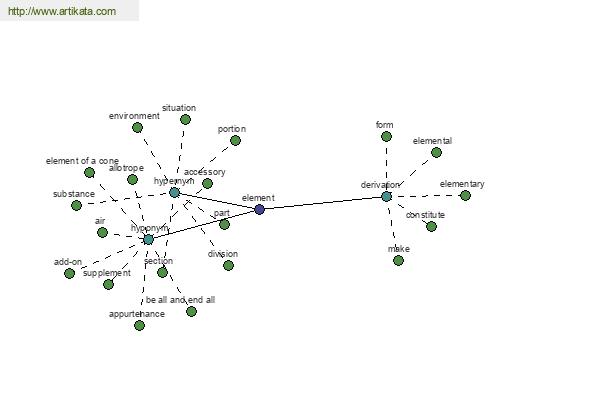 Explore element in ArtiKata.com >